Recently shipped ElevenLabs speech models, a half-price Batch API, and Private Endpoints for routing your own deployments.
ElevenLabs brought speech to the same API key. Nine text-to-speech models and two speech-to-text models are now callable through POST /api/v1/audio/speech and POST /api/v1/audio/transcriptions. Eleven v4 handles narration with control over tone and delivery, v4 Turbo gives agents faster spoken replies, and Scribe v2 transcribes conversations with speaker labels. No separate ElevenLabs plan is required, and every model was 50% off through October 19.
Batch API cut prices for work that can wait. Bundling requests lets the provider choose when within a 24-hour window to run them, typically at half the per-token price, across 70+ models. It rarely takes that long: across 230k+ batches run during beta, the median finished in 7 minutes and 90% within an hour.
Private Endpoints route your own models and capacity. Fine-tuned models, dedicated deployments, and provider-reserved capacity can now sit behind the same API, model slugs, and routing preferences as the public catalog, visible only inside your organization. It is an Enterprise plan add-on.
Security Center puts every API key in one place. Available on all plan types, it shows keys across workspaces and lets you disable, archive, or cap hundreds at once. An audit of the company's own org turned up 1,000+ active keys for 85 employees, 168 unused for months.
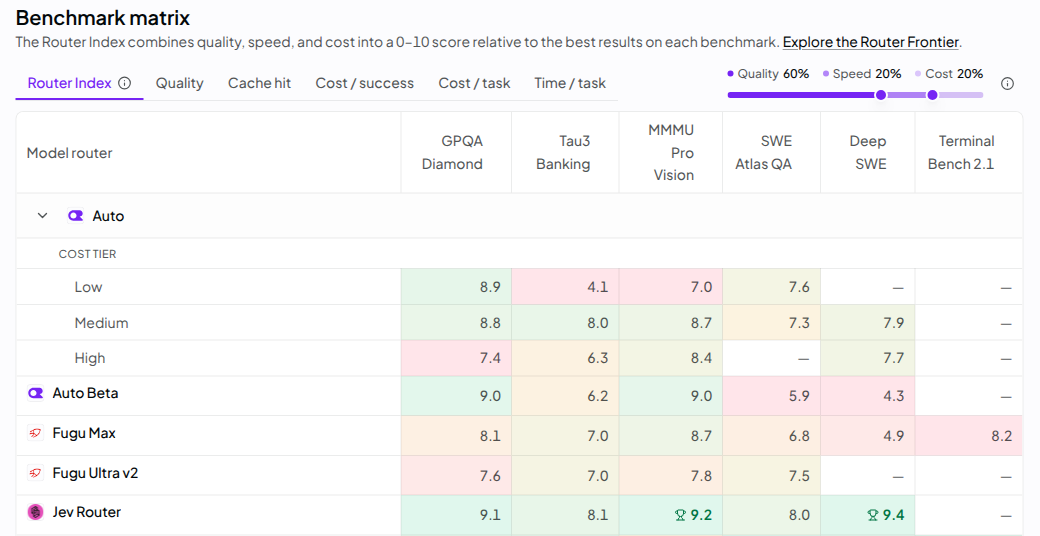
Router comparisons got a benchmark page. Model Router Benchmarks scores routers on quality, speed, and cost, with individual models shown as baselines.