
npx @buildinternet/releases get datadogRecently shipped Deployment Gates, End User Device Monitoring, and Scout 1.0, the SRE model behind Bits Investigations.
Deployment Gates is generally available and pauses a rollout when application or infrastructure health degrades as changes reach production. It combines Datadog monitors with automatic detection of unexpected errors, so a bad deploy stops before more customers hit it.
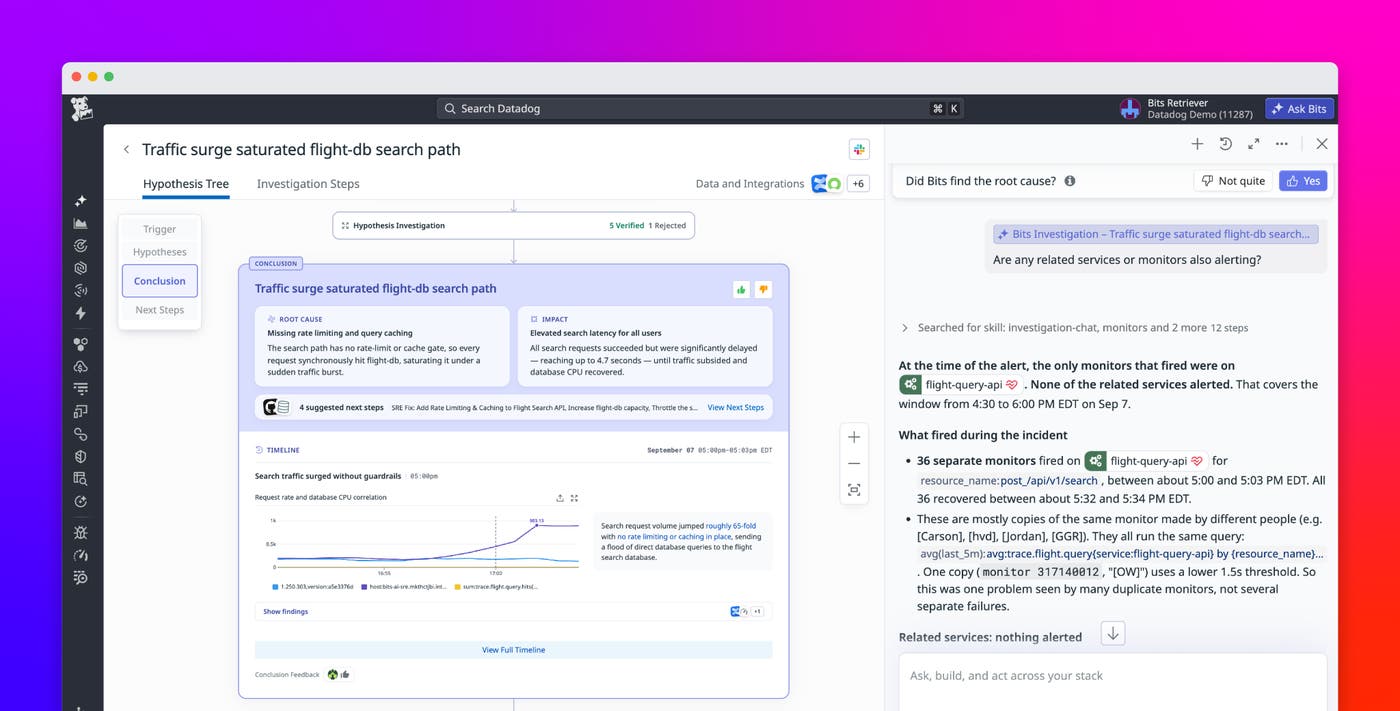
Bits Investigation now averages about $4 and roughly two minutes, down from $25 and 11 minutes at launch. Average cost fell 84% and investigation time dropped 82%, while quality scores rose 44%. Scout 1.0 matches larger general-purpose models at an estimated 3–8× lower inference cost.
Agent Observability now covers the parts of an LLM app that sit outside the release cycle.
- Prompt Management versions, deploys, and retrieves prompts independently of application releases, and Prompt Tracking ties each version to the calls that used it.
- Online Experiments compare agent variants against live production traffic, measuring quality, reliability, and cost before you roll a change out.
- Fireworks AI joins as a model provider, so open models can run LLM-as-a-judge evaluations and Playground experiments.
- AI Guard applies runtime guardrails against prompt injection, including the self-replicating attacks OpenAI described.
- Agent Observability is available on Anthropic's Claude Marketplace.
End User Device Monitoring extends the Agent to employee laptops and workstations, giving IT teams device health alongside network and application context. Meanwhile, Kubernetes inference workloads are in Preview: Kubernetes Explorer connects the orchestration config declared in custom resources to the pods and runtime metrics it produces.
RUM reaches surfaces it previously could not see, and keeps sessions it used to discard.
- RUM Profiling connects code-level CPU profiles to real user sessions on iOS and Android.
- The C++ SDK collects crash diagnostics from native apps on Windows, macOS, and Linux.
- The Electron SDK merges Node.js main-process errors and requests into the renderer's session timeline.
- RUM Managed Archive retains sessions that retention filters drop, and Export Pipelines continuously send RUM and Product Analytics events to storage you control.
Agent 7.85 disables the Health Platform by default on Kubernetes, including EKS Fargate, to stop Autodiscovery stalls; set health_platform.enabled: true to restore it. Agent 7.85.0 also requires an external Oracle client 19c or newer for the Oracle integration. If you customized the Agent-installed private-action-runner/script-config.yaml, back it up before upgrading past 7.84.3 and copy it back afterward.
Elsewhere, dd-trace-py 4.17 adds Python 3.15 support and drops the legacy pytest plugin, so DD_PYTEST_USE_NEW_PLUGIN no longer has any effect. dd-trace-js 6.24 expands Feature Flags and LLM Observability, and the Browser SDK allows setting user and account at init.
