Releases Index

Infrastructure

Recent releases from organizations and products in the Infrastructure category.

TueNov 3, 20261 release
Cloudflare
Application Security

Top personal agents get individual access policies

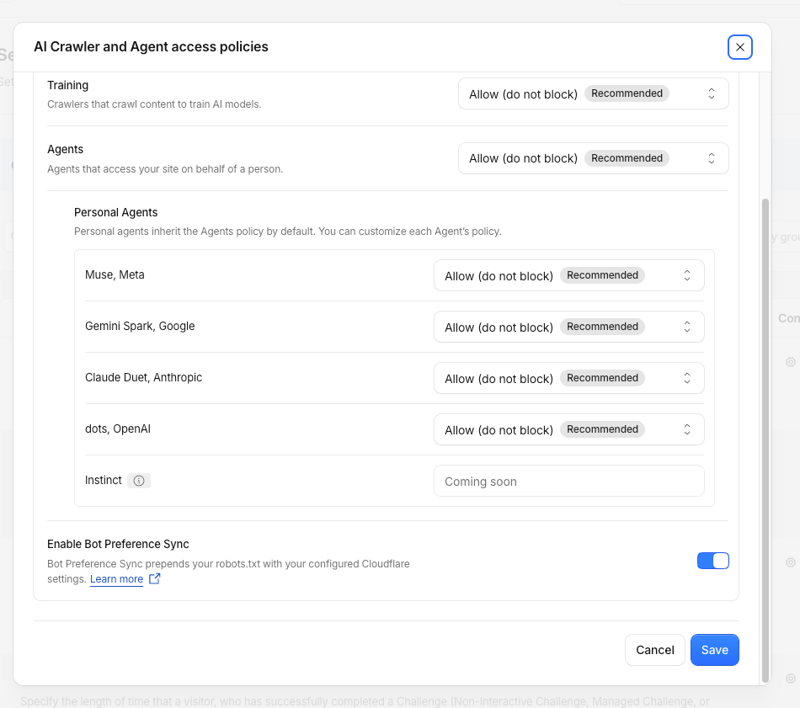
The Configure AI bot policies setting is now named AI Crawler and Agent access policies, and lets you set actions for the top Personal Agents individually. Personal Agents inherit the existing Agents policy by default, and Cloudflare recommends Allow (do not block) for them.
Details
AI Crawler and Agent access policies dialog showing the Agents policy and individual Personal Agents settings
MonNov 2, 20265 releases
CloudflareTemporal

Developer Platform

2 updates

Pi now batches streamed answers and tool output instead of persisting every update, cutting SQLite storage transactions by about 27x for long answers and reducing CPU and memory when streaming large tool calls. session.watch() replaces session.events(), session.continue() starts a new run without a new message, and retry() and the parked status are removed.

Details
Pi 1.5 cuts storage writes 27x; Pi 1.4 cannot read new sessions

Browser Run /crawl results now include an outcome for each URL record, identifying results such as success, robots_disallowed, or timeout. A job-level robots array reports the robots.txt state for up to 50 origins, including whether usable rules were available and the HTTP status received.

Details
SunNov 1, 20265 releases
Cloudflare
Cloudflare One

Service tokens get tags; authorize by env or team

Access service tokens now support up to five key-value tags, editable in the dashboard or service token API, searchable on the Service Tokens page, and queryable in Resource Tagging. A new Service Token Tag policy selector matches tokens by exact key-value pair in a Service Auth policy, so access can be granted by environment or team without listing each token.

Details

Developer Platform

4 updates

Workers with a compatibility date of 2026-11-17 or later receive client disconnection events through request.signal by default, removing the need for the enable_request_signal flag. Existing Workers keep current behavior until their compatibility date changes; the new date also supports opting out with disable_request_signal, and does not enable request_signal_passthrough.

Details

JavaScript Workers with a compatibility date of 2026-11-17 or later use the new module registry by default and no longer need the new_module_registry flag, while Python Workers stay on the legacy registry. The new registry rejects invalid import attributes and fails require() calls when the module or a dependency uses top-level await; add legacy_module_registry to keep the old behavior.

Details

AI Search billing now begins December 1, 2026 instead of November 1, 2026, with pricing and included usage unchanged. The default sync interval for AI Search instances changes from 6 hours to 24 hours, though any interval from 15 minutes to 24 hours remains selectable via the Sync interval setting or the sync_interval API field.

Details

Flagship bindings now evaluate flags against a local flag store during local development instead of calling the remote app, applying to wrangler dev, the Vite plugin, Vitest integration, and cf dev. The store starts empty so evaluations return the default value in code, and flags can be managed via --local in wrangler and cf commands, Local Explorer, or pulled from the remote app with wrangler flagship flags pull; set remote: true to keep evaluating remotely.

Details
FriOct 30, 20261 release
Cloudflare
cloudflared2026.10.7
ThuOct 29, 20268 releases
Cloudflare

Application Security

2 updates

Rule detection is updated across the Cloudflare Managed, Free, and Response rulesets for PHP out-of-memory vulnerabilities CVE-2026-109618, CVE-2026-109619, and CVE-2026-115560, based on researcher reports from Cloudflare's PHP CTF challenge. Detection actions remain Block.

Details

An emergency release adds a disabled-by-default Cloudflare Managed Ruleset rule for a vulnerability in Nuxt Image and IPX, offering only partial coverage; the advisory recommends patching to the latest version.

Details

Cloudflare One

2 updates

Cloudflare WAN traffic can now use a Gateway processing region with Regional Services, keeping HTTPS traffic encrypted until Gateway forwards it to the selected region for TLS decryption and HTTP inspection. The feature requires unified routing, applies only to Gateway HTTP traffic rather than DNS or network policy processing, and is configured through your account team.

Details

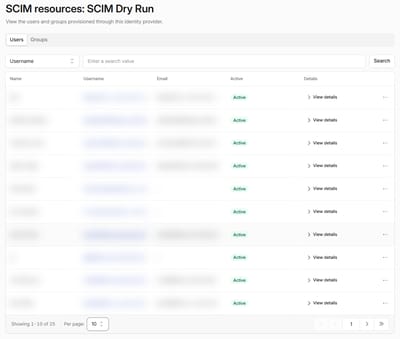
The SCIM population viewer in Zero Trust > Integrations > Identity providers lets admins search provisioned users and groups, inspect attributes in formatted or JSON views, view group members, compare Cloudflare and IdP resource IDs against provisioning logs, and delete individual resources with edit permission. The viewer shows provisioned resources rather than provisioning event history; deprovisioning and policy behavior are unchanged.

Details
SCIM users table with search controls and blurred personal information
Application Performance

Keyless SSL with ECDSA certs now negotiates TLS 1.3

v1.3

When TLS 1.3 is enabled on a zone, visitors connecting to a hostname that serves a Keyless ECDSA certificate now negotiate TLS 1.3 while private keys stay on the customer's own key server. Keyless SSL connections using RSA certificates continue to negotiate up to TLS 1.2.

Details

Developer Platform

3 updates

Browser Run now runs Chrome 152 by default, and the default User-Agent for Quick Actions reports Chrome 152 instead of Chrome 119, so allowlist or User-Agent matching rules may need updating. Also fixes large response headers not loading, makes /links return absolute URLs while links-only crawls follow relative links, preserves code block languages in Markdown output, and removes distrusted root certificates.

Details

Beginning November 4, 2026, D1 queries returning more than 50 MB will fail with a "query result exceeded the maximum response size limit" error, a threshold that covers the 99.999th percentile of requests. Import and export via the REST API are exempt; users with large results should select specific columns instead of SELECT * and paginate with LIMIT and OFFSET.

Details

Deploying new Durable Objects code no longer applies immediately; an active object can keep running its current code for up to 300 seconds while waiting to hibernate, letting in-flight work finish and Hibernation API WebSockets stay connected. The delay is configurable via code_update_strategy in Wrangler with max_delay from 0 to 86400 seconds, or per deployment with --durable-objects-code-update-mode immediate or deferred.

Details