---
name: Stripe Blog
slug: stripe-blog
type: feed
source_url: https://stripe.com/blog
organization: Stripe
organization_slug: stripe
total_releases: 25
latest_date: 2026-07-21
last_updated: 2026-08-11
tracking_since: 2026-01-16
canonical: https://releases.sh/stripe/stripe-blog
organization_url: https://releases.sh/stripe
---
Stripe doubled down on agentic commerce as a platform direction, shipping infrastructure for AI agents to transact natively alongside tooling to help merchants optimize those interactions. The Machine Payments Protocol launched as an open standard for agent-to-merchant payments, while Adaptive Pricing expanded to subscriptions and delivered measurable lift—4.7% higher conversion and 5.4% higher LTV in a 1.5M session test. Radar shifted focus to first-party fraud, detecting 6.2x more abusive free trials in recent months and adding one-click prevention that reaches 90% accuracy.
## Analyzing the evidence that helps businesses win “product not received” disputes
# Analyzing the evidence that helps businesses win "product not received" disputes
[Product not received](https://docs.stripe.com/disputes/categories) disputes—where a cardholder claims they didn't receive what they paid for—are the most common nonfraud dispute category on Stripe. It can be challenging to know which claims are legitimate and which are not: some customers genuinely never received what they paid for, while others incorrectly claim they didn't receive the order.
To understand what can influence win rates, we analyzed evidence packets from one million disputes over a 16-week period. We compared win rates for packets that included various types of evidence—such as delivery confirmation or content consumption logs—against those that didn't, isolating which features correlated with higher win rates.
Here's what the data shows for businesses broadly, what's different for businesses selling digital goods, and what it means for how you mitigate disputes.
## **Businesses that submitted delivery information saw a 44 percentage point higher win rate**
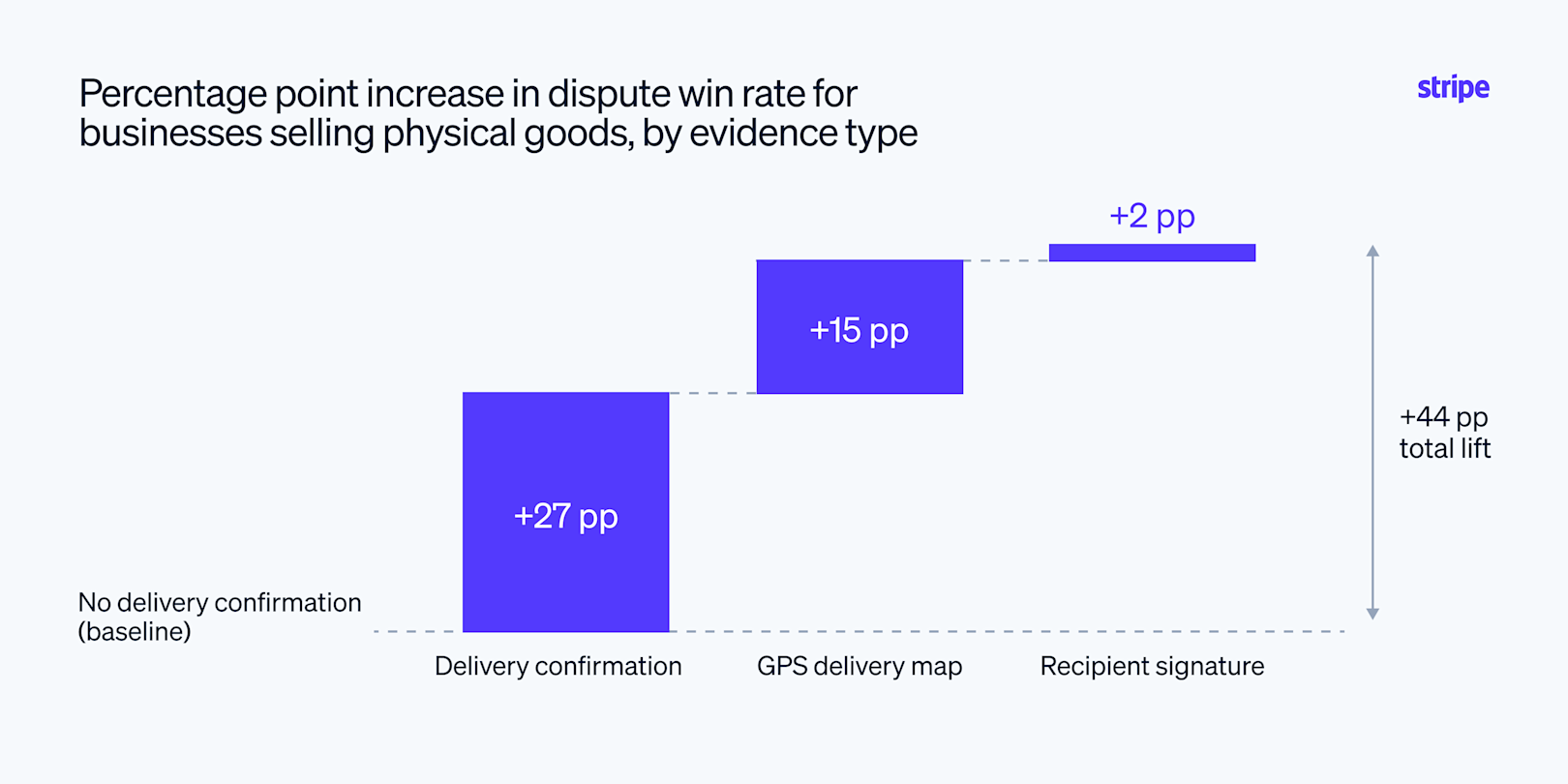
For businesses selling physical goods, disputes with delivery confirmation as evidence had a 27 percentage point higher win rate than disputes without it. Adding a GPS delivery map as evidence, which shows where the carrier scanned the package, lifted win rates by an additional 15 percentage points on top of delivery confirmation alone. And including a recipient signature as evidence added a further two percentage point lift. Together, disputes with delivery confirmation, a GPS map, and a signature had a 44 percentage point higher win rate than disputes without them.
Yet many businesses still don't include delivery confirmation in their dispute responses. Part of this gap is awareness, but the bigger barrier is operational. For most businesses, shipping data and dispute workflows live in separate systems. Matching a specific dispute to the right order and confirmed delivery status often requires manual work and is hard to scale.
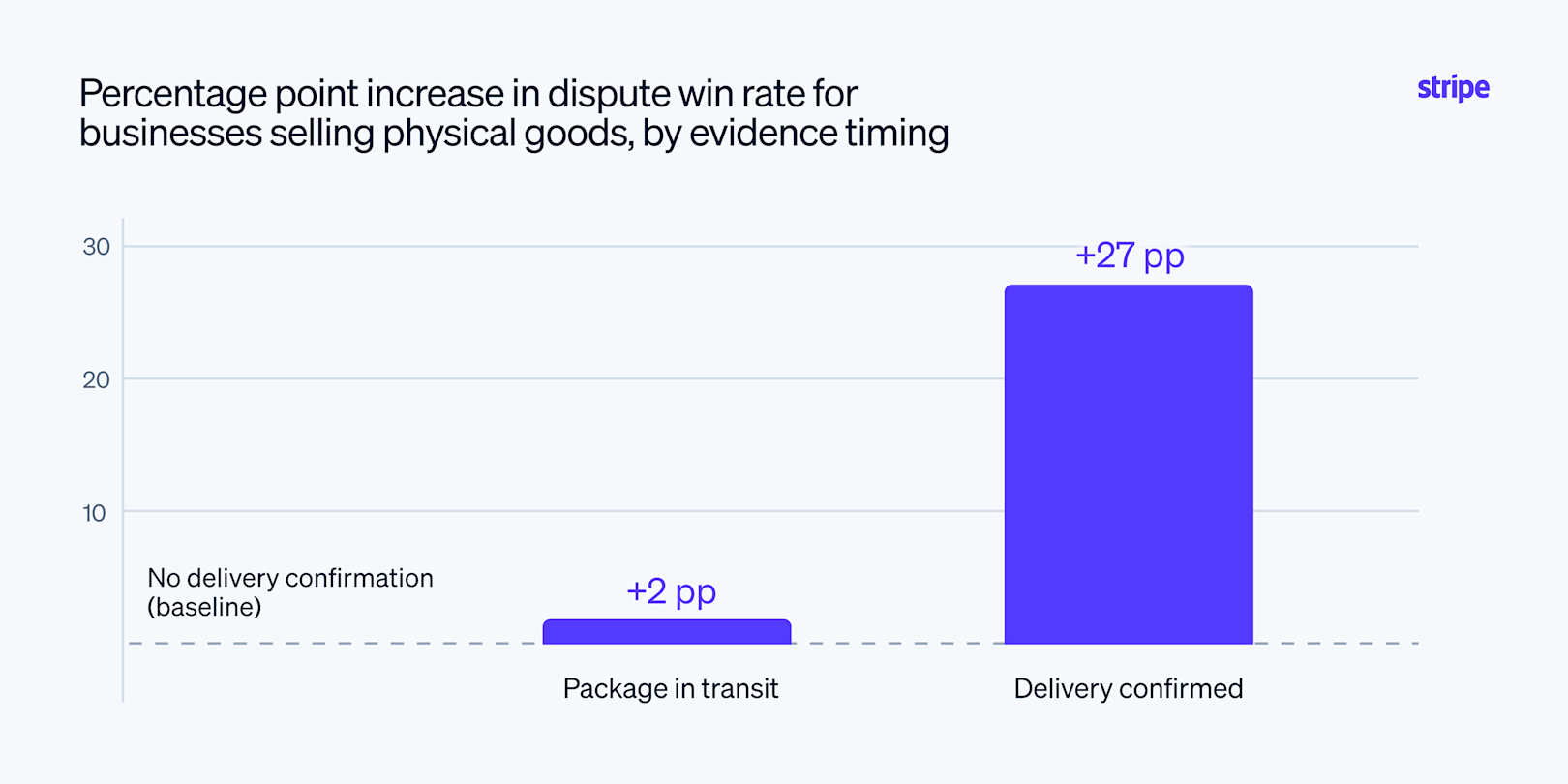
## Businesses that submitted evidence after the delivery was confirmed saw a 27 percentage point higher win rate
Many businesses submit a shipping tracking ID as proof of delivery. However, depending on the status of the package at the time you submit the evidence, the tracking number might only confirm that the package left your facility.
Our analysis found that win rates increased based on what the tracking ID showed when a business submitted it—specifically, whether delivery had been confirmed. Disputes with evidence submitted after delivery was confirmed had a 27 percentage point higher win rate than disputes with no delivery confirmation. On the other hand, disputes with evidence submitted when the package was still in transit had only a two percentage point higher win rate than disputes with no delivery confirmation.
This suggests that the timing of your evidence submission matters. Customers might file a "product not received" dispute before an order arrives, especially if a shipment is delayed or still in transit. Because most businesses have 20 or more days to respond, consider holding your submission until the carrier confirms arrival if your dispute window allows it. If you do need to submit before delivery is confirmed, consider including documentation showing that the order is still within the delivery time frame the customer agreed to at checkout.
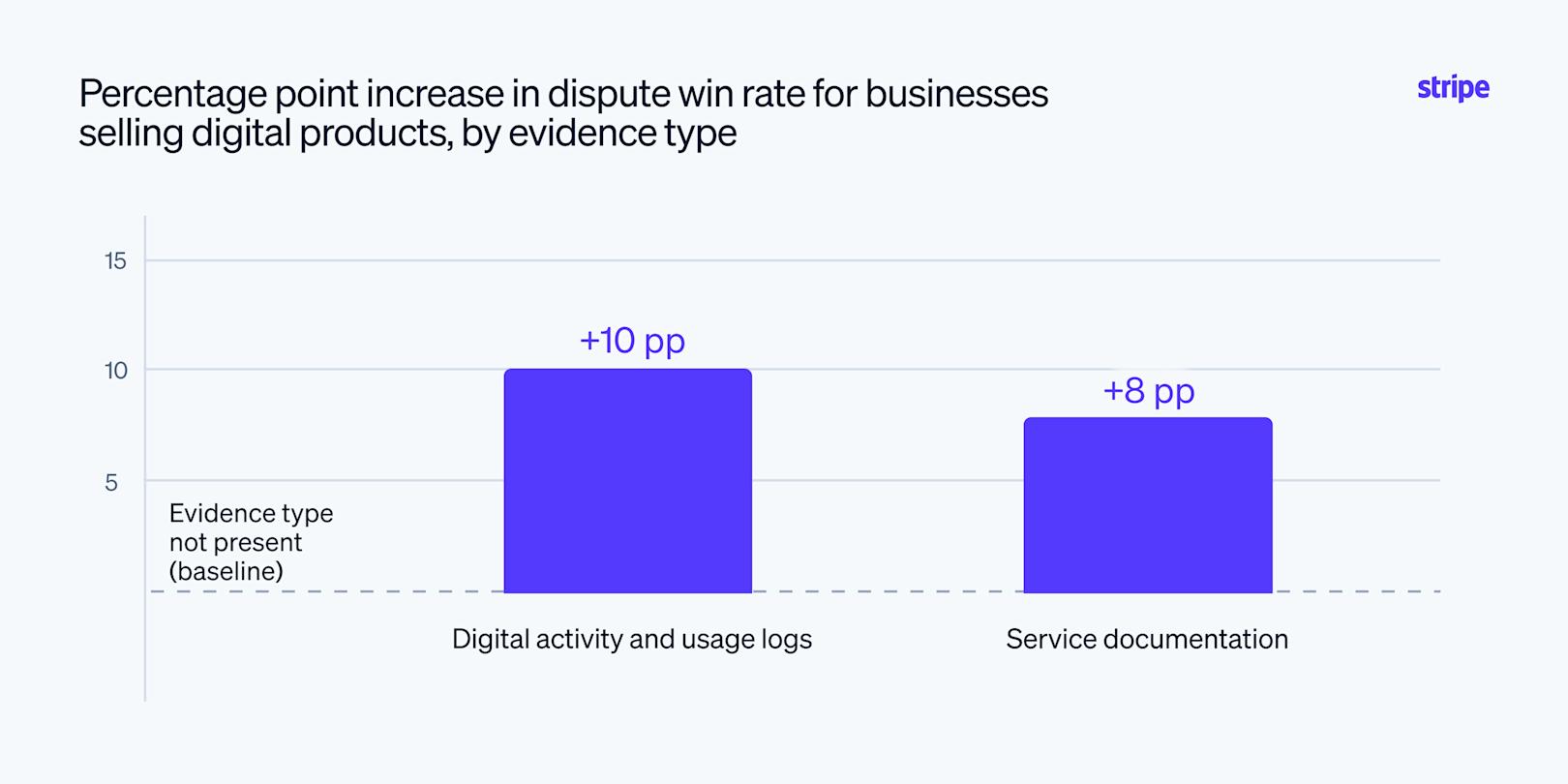
## Businesses that submitted digital activity and usage logs saw a 10 percentage point higher win rate
Businesses selling digital goods also need to provide proof of fulfillment, though the supporting evidence looks different.
Disputes with digital activity and usage logs—such as JSON telemetry logs from common analytics platforms showing that a user streamed, downloaded, or accessed the specific product they purchased—had a 10 percentage point higher win rate than disputes without them. And disputes with service documentation, such as provisioning records, had an eight percentage point higher win rate than disputes without them.
The pattern mirrors what we found with businesses selling physical goods: specificity is always better. Service documentation might only prove that a customer had access. On the other hand, content consumption logs might prove customers streamed, downloaded, or accessed the specific product they paid for.
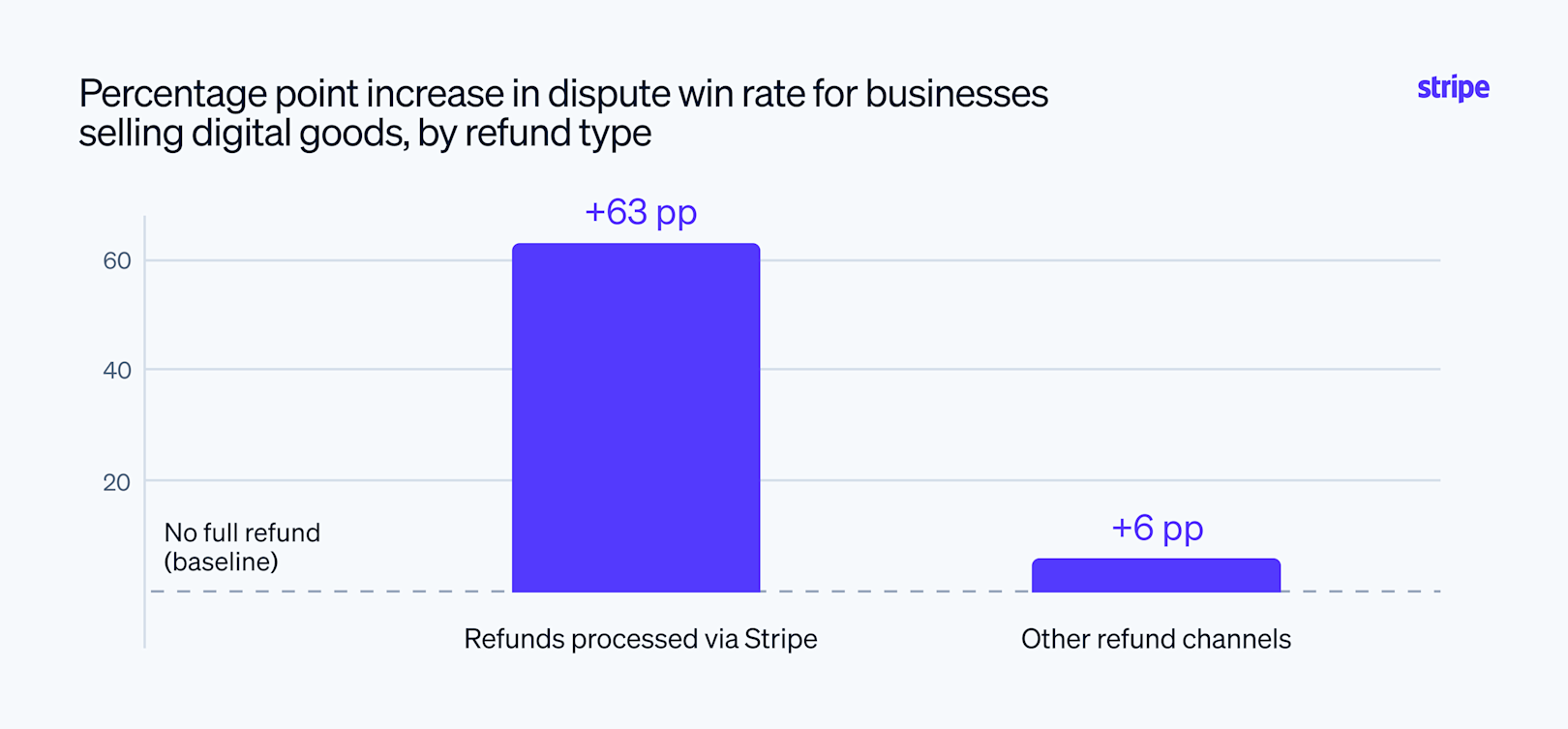
## Businesses that included evidence of a refund issued through Stripe saw a 63 percentage point higher win rate
Cardholders can still initiate [a dispute even after a refund has been processed](https://support.stripe.com/questions/disputes-on-a-refunded-transaction-faq), often because the refund and dispute were filed around the same time or because the issuing bank didn't check the refund status before filing the dispute. When this happens, many businesses include refund evidence in their dispute responses as proof they've already made the customer whole. But our analysis showed that the impact of "proof of refund" on win rates for businesses selling digital goods depended on how the refund was processed.
A full refund issued through Stripe was the strongest predictor of high win rates for businesses selling digital goods. Disputes that included this type of evidence had a 63 percentage point higher win rate than disputes that didn't include it. On the other hand, disputes with refunds issued via other channels, such as store credit, saw only a six percentage point lift compared to disputes that didn't include it.
This might be because issuers can only act on information they can verify. When a refund is processed through your payment processor, the issuing bank can verify that credit on the card network. A refund issued outside of your payment processor can't be verified in the same way by the issuer; there is no record.
## How Stripe can help
[Smart Disputes](https://docs.stripe.com/disputes/smart-disputes) is designed to apply these best practices for you, helping you save time and recover revenue. It uses AI to automatically assemble tailored evidence packets for eligible card disputes, applying the same data-backed best practices identified in this analysis, so you don't have to manually implement them dispute by dispute.
You can increase your win rates by providing Smart Disputes with a shipping carrier and tracking number when you receive a dispute. Stripe supports more than 12 shipping providers and automatically works with them to pull the entire fulfillment history, such as delivery status, time stamps, and location data. You can also add any additional evidence, such as customer communications or supplementary documentation, and Stripe will merge it with the auto-generated packet to create the strongest possible response.
Stripe then assembles that information into a compelling evidence packet for you, optimizing packet content and structure based on the specific dispute, down to the network, region, issuer, and reason code. If you don't take any action before the dispute deadline, Smart Disputes submits the evidence on your behalf to ensure disputes are not lost due to missed deadlines.
No additional integration is required if you already use Stripe. To learn more about Smart Disputes, [read our docs](https://docs.stripe.com/disputes/smart-disputes).
*The insights, projections, and forward-looking statements contained here are for informational purposes only and should not be relied upon. These are based on assumptions and information currently available, but actual results may differ materially.*
## Four travel and hospitality trends from HITEC 2026
# Four travel and hospitality trends from HITEC 2026
More than 6,000 hospitality executives and operators gathered in San Antonio last week for the annual HITEC hospitality technology conference, including leaders from Wyndham Hotels & Resorts, Hyatt, IHG Hotels & Resorts, Starwood Hotels, and hundreds of independent properties.
The big topic: whether the industry's AI investment is actually working. IDC forecasts that [30%](https://www.idc.com/resource-center/blog/agentic-ai-will-redefine-travel-and-hospitality-in-2026/) of all travel bookings will be made by AI agents by 2030. But the gap between where the industry is headed and what it's currently equipped to support is wide.
While 25% of hospitality businesses report actively scaling AI today, fewer than 10% are considered "AI future-built," according to [BCG](https://www.bcg.com/publications/2026/ai-first-hotels-leaner-faster-smarter)—meaning they have AI embedded across core operations, a supporting data foundation, and measurable returns to show for it. "A lot of companies are throwing spaghetti at the wall to see if it sticks," said Dale Gomez, associate teaching professor in hospitality technology at Florida International University. "They want to see ROI."
Other shifts are already underway. Many hospitality businesses still lack the modern financial infrastructure needed to fully benefit from the automation, speed, and interoperability AI is expected to drive. Payment systems once considered "good enough" are now costing measurable revenue, and rising guest expectations have turned inefficient technology from a minor inconvenience to a reason not to return.
Across four days and over 50 meetings, four trends stood out.
## The race for direct bookings has moved from search rankings to AI answers
For years, the hospitality industry's answer to online travel agency (OTA) dependency was SEO: invest in content, improve search rankings, and convert guests before they end up on Expedia or Booking.com. That approach is becoming less effective.
Jack Wang, principal solution engineer at Salesforce, offered data that spotlights a shift: 65% of Google searches that trigger an AI Overview now end without the user clicking any website. On mobile, that number climbs to 78%. Traditional search traffic is declining roughly 25% across the industry, as AI-generated summaries replace the ranked link lists that SEO was designed to win.
Inclusion in an AI-generated answer requires something different from what SEO rewards. SEO responds to keyword density, backlinks, and page authority. AI inclusion responds to the accuracy and machine-readability of structured property data, like room types, amenity details, policies, local context, or cancellation terms. A hotel can rank well in traditional search and be invisible to an LLM: over [90%](https://www.nokumo.net/en/ai-visibility-in-hospitality-what-3-600-ai-responses-and-1-337-website-audits-reveal?utm_campaign=ennismore-proves-tech-investment-pays-off-and-94-of-hotels-are-invisible-to-ai) of accommodation sites are still undetected by AI models.
We're already seeing a downstream effect. According to Phocuswright research, [56%](https://www.phocuswire.com/news/online/shift-travel-behavior-ai-surge-phocuswright-research) of travelers have used AI for trip planning, booking, or in-destination assistance in the past 12 months. For operators, the first step is an audit, not an investment. Can the LLMs your prospective guests are using accurately describe your property's room categories, amenities, policies, and local context? If the answer is no, that gap is likely costing you bookings.
Today, hotel chains have access to the same checkout and payment tools as OTAs, including local payment methods and currencies, one-click checkout, and global fraud protection. The travel brands capturing agentic demand are combining AI-driven discoverability with accurate real-time inventory and a modern checkout experience that converts demand efficiently.
## Most hospitality AI is falling short in a predictable way
An uncomfortable truth surfaced repeatedly throughout HITEC: much of the AI scaling happening across hospitality is fragile. The majority of businesses are adopting AI without the strategic clarity, data foundation, and operational architecture to sustain it.
The root cause is often fragmented data. Siloed property management, CRM, loyalty, food and beverage, and payment systems each hold partial views of the same guest—and AI recommendations are only as accurate as the content they draw on. The same data problem that breaks AI personalization shows up in finance as excessive reconciliation time, in operations as incomplete guest profiles, and in the guest experience as friction.
Amanda Sharp, Salesforce lead solution engineer, reframed the problem as AI operationalization rather than adoption, calling for "vibe operating": hospitality's answer to vibe coding. Building AI features is now feasible for many hotel brands. Running them reliably in production, integrated into actual workflows that trigger real actions, is harder.
The businesses doing this well have clean, connected data that delivers useful intelligence directly into the workflow while there's still time to act. At Delta Air Lines, for example, a live AI concierge is built into the mobile app and uses SkyMiles profile and operational data to provide context-aware support as part of the customer care experience. At Wynn Las Vegas, revenue managers receive predictive alerts when performance is trending below target, along with recommended actions attached.
For most travel operators, the bottleneck is data connectivity rather than model quality.
## Payments friction has a measurable cost, but most hotels still don't know what it is
The hospitality industry has historically treated payments as a cost and commodity: something to keep running, minimize fees on, and keep out of the way. Many of the payments-specific conversations we had at HITEC revolved around how that approach is changing, along with a growing recognition that payments have become a key factor in how hospitality brands compete. Our own data supports this: in a Stripe-commissioned [survey](https://go.stripe.global/rs/072-MDK-283/images/Skift_x_Stripe_How_Payment_Systems_Are_Changing_in_Travel_and_Hospitality.pdf) of nearly 400 hospitality executives, 90% said payments are important to growth, and 37% said that a lack of payment options has the greatest negative impact on the guest experience. In addition, 58% said their fraud systems block legitimate transactions, and 74% reported that fragmented systems cause their teams to spend excessive time on reconciliation.
Those figures highlight why payments have become a structural advantage. OTAs can afford to staff payments at scale because their revenue justifies the head count. Independent hotels and smaller operators can't match that investment directly, but a lean team on the right infrastructure can now support payment methods across dozens of countries at a fraction of the cost of a large in-house operation.
A coverage gap translates directly to lost bookings. "The moment we don't support \[a payment method\] is the moment this guest goes elsewhere, to a platform or channel that supports their preferred way to pay," said Sebastien Leitner, VP of strategic partnerships at Cloudbeds. Guests book where their preferred payment method works. A property that doesn't support the dominant method in a target market isn't just creating friction—it's routing that booking to an OTA that does.
## The best hospitality technology is the kind that goes unnoticed
"There is zero empathy for technology that doesn't work," said Tanya Pratt, global VP of strategy and product management at Oracle Hospitality. "If it's not working, it's going to cause more frustration than if there's a line at the front desk, because people are used to that." When technology fails, guests don't always complain. They just don't come back.
The real gauge of success is when technology works well enough that guests don't think about it at all. Denise Walker, CIO of Starwood Hotels, described the vision: a returning guest arrives to a room at the right temperature, with their preferred channels on the TV, and pillows of their preferred firmness on the bed. No one announces how they knew. "It doesn't have to be delivered in a way that says, 'How did you know that?'"
Shannon McCallum, VP of hotel operations at Resorts World Las Vegas, went further. "We're moving from 'I told you this, so you know it about me' to 'I didn't tell you anything, and now you're predicting it.'"
Both the invisible personalization and the human moments it enables require a foundation of connected data—tech that integrates across your existing stack, consolidating guest information into a single system. That infrastructure allows businesses to recognize the same guest whether they're browsing your website or standing at the front desk.
## How Stripe can help
Increasingly, guests will find your property through AI assistants rather than search engines. The bookings they make might be completed by agents. And the revenue that distinguishes high-performing operators will come from payment experiences that convert, payment methods that cover every market, and financial systems that work together. Stripe Data Pipeline connects payments data with your booking and customer systems, giving operators a unified view of revenue without stitched-together reporting.
Stripe's payments infrastructure helps hospitality operators protect revenue, boost guest spend on-property, and simplify operations.
**Drive direct bookings.** Across the payment methods guests actually use and in every market you serve, payment experiences that convert help keep bookings on your direct channel. As agentic commerce scales, that means fraud detection that runs on every Stripe transaction by default and payment tokens that allow agents to transact without exposing guest credentials.
**Increase trip spend.** Ancillary revenue from dining, experiences, and partnerships requires payments infrastructure that works across the property, supports new business models, and connects with external partners. Stripe Billing handles the recurring payment logic behind membership and loyalty programs, including automatic renewals, tiered pricing, and failed payment recovery—without requiring operators to maintain that infrastructure themselves. [Cloudbeds](https://stripe.com/customers/cloudbeds), for example, saw 15% revenue growth for businesses using Cloudbeds Payments and a 14.8% average increase in revenue for businesses expanding payment methods by directly removing payment friction through its Stripe partnership.
**Cut costs.** More efficient B2B money movement and fraud protection reduce reconciliation work and limit losses, freeing up margin without adding staff.
[Learn more](https://stripe.com/industries/travel) about how Stripe supports hospitality businesses, or [get in touch](https://stripe.com/contact/sales).
## What Link data tells us about AI spending
# What Link data tells us about AI spending
We surveyed 394 customers who use [Link](https://stripe.com/payments/link), a digital wallet built by Stripe, on their AI habits. Eighty percent had used a chat-based agent in the past month, and half had used AI for shopping research at least monthly.
Has that usage translated into spending? To find out, we analyzed spending patterns across the 250 million customers paying with Link. We found that Link customers are spending more on AI than they were three months prior, investing heavily in platforms that let them build with AI.
Here's what the data shows.
### Link customers are spending more on AI products each month
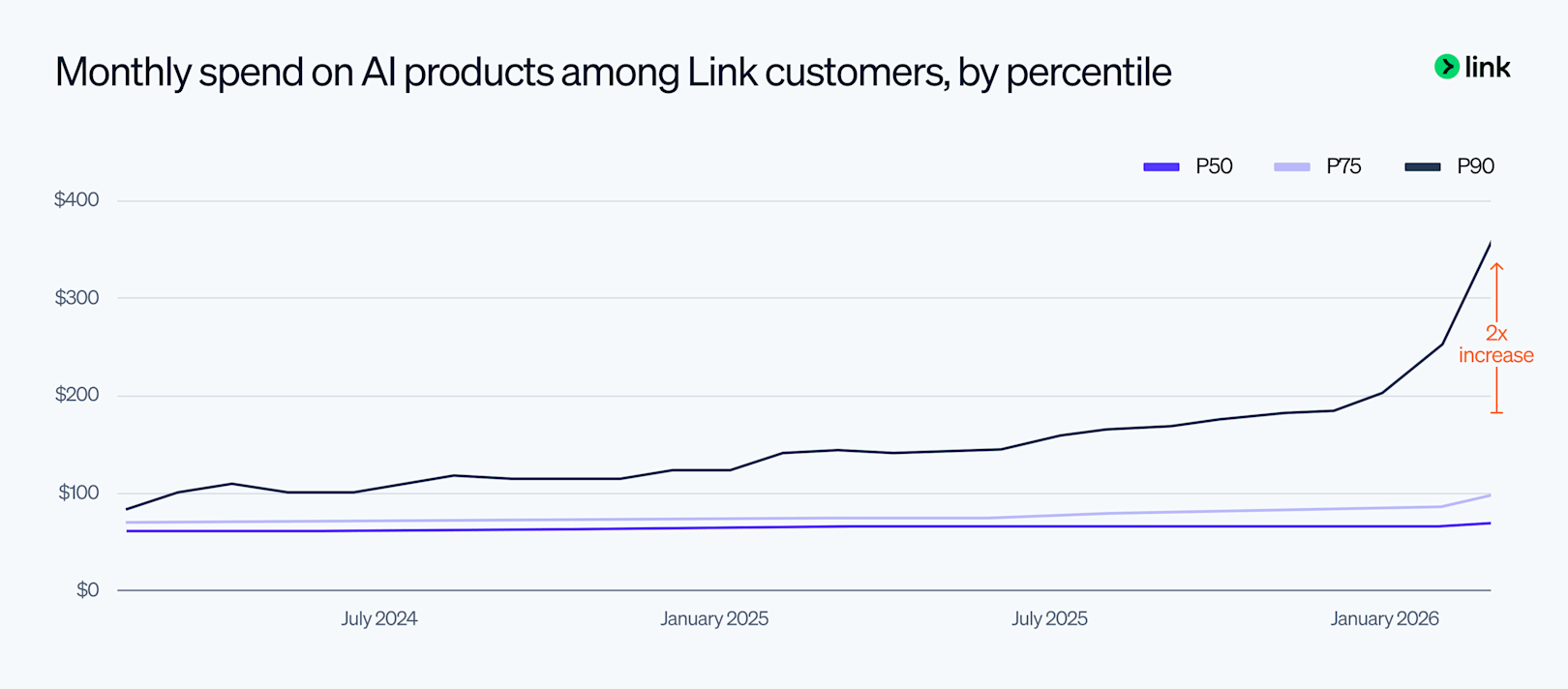
We grouped Link customers by their monthly spend on AI products. The top 10% of Link customers with the highest spend on AI products increased their monthly spending from $183 in December 2025 to $359 in March 2026—nearly doubling in a single quarter.
What's notable is the timing: it took 22 months for that same cohort to grow from $84 to $183, but only three months to double from $183 to $359. Even at the 50th percentile, monthly spending on AI products increased from $60 to $72 over the same period.
### Link customers are spending more on AI app-builder platforms
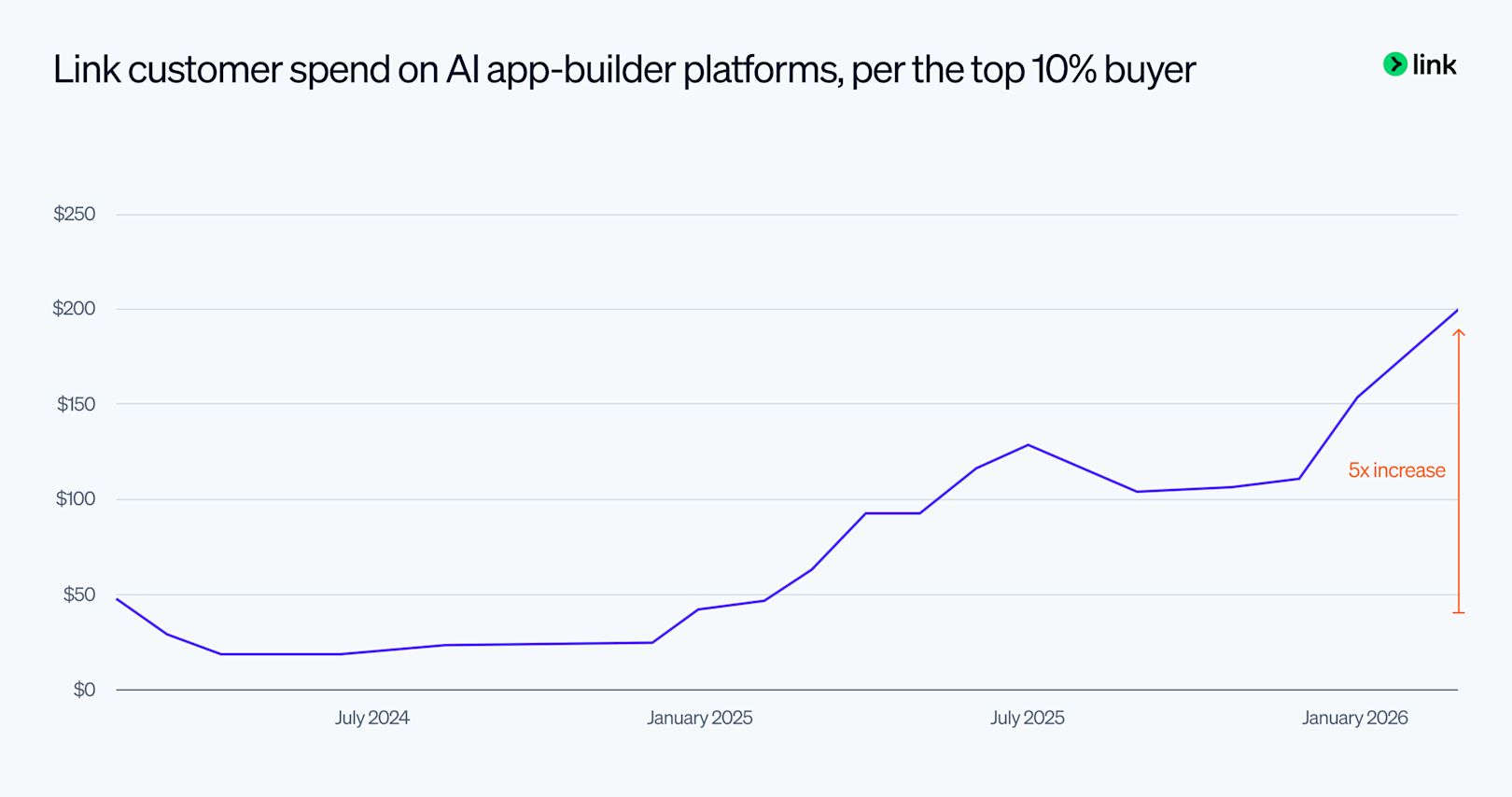
When we isolate spending on app-builder platforms like Replit, Lovable, and Bolt, the growth is even more pronounced. The top 10% of Link customers with the highest spend on AI products are now spending 5x more on app-builder platforms each month compared to January 2025.
### Building the infrastructure to support agents
Link customers are spending more on AI and using agents for shopping research. As these agents become more capable, they'll increasingly need the ability to transact with businesses and one another.
That's why we built [Link's wallet for agents](https://link.com/agents). It lets customers authorize agents to pay on their behalf with spending controls they set, gives agents broad purchasing access across any seller on Stripe, and gives businesses verified transactions without complex integrations.
Learn more about how you can give agents the ability to pay with [Link's wallet for agents](https://link.com/agents).
## Stripe Projects adds new agent integrations, more providers, and custom developer controls
# Stripe Projects adds new agent integrations, more providers, and custom developer controls
Last week, [agent traffic surpassed human traffic](https://radar.cloudflare.com/traffic#bot-vs-human) on the internet for the first time. Agents browsing webpages account for some of that traffic, but Stripe data points to a more significant reason for this growth: agents building software.
Agent traffic to Stripe's documentation grew more than 10x in 2025 and now makes up nearly 40% of docs traffic. We've also seen exponential growth in new [Stripe CLI](https://docs.stripe.com/stripe-cli) users over the past year, with 70% of CLI requests for API resources coming from agents.
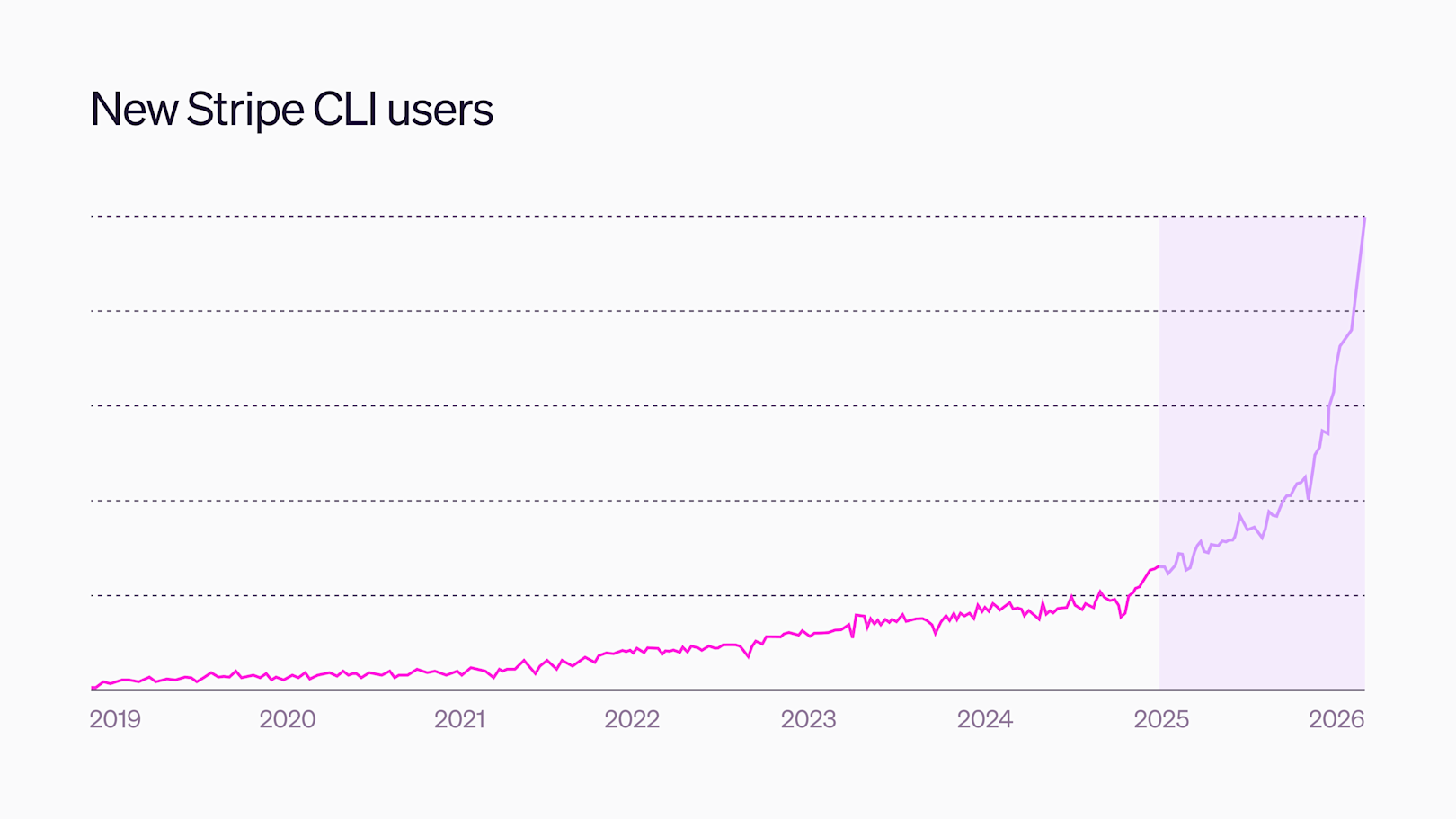
Our data shows that agents are now fully capable of independently writing code and integrating with APIs like Stripe's. And yet, many of the steps adjacent to writing code—such as provisioning infrastructure, managing credentials, setting up accounts, and connecting services together—are still too hard for agents to do on their own.
We're expanding [Stripe Projects](https://projects.dev/), which lets you provision and manage services from the CLI, to solve this with new agent integrations, additional providers, and new developer controls.
Here's what's new with Projects.
## Hermes, Factory Droids, and Warp agents can provision infrastructure directly
Stripe Projects is now available as a skill—a set of structured instructions that give agents the context to act—in [Hermes](https://hermes-agent.nousresearch.com/), an open-source, self-improving AI agent from Nous Research. Stripe Projects handles infrastructure provisioning and management, while Hermes carries context across sessions. This means that if you're building a complex product over days or weeks, your agent is a persistent collaborator—returning to a project the same way a developer would.
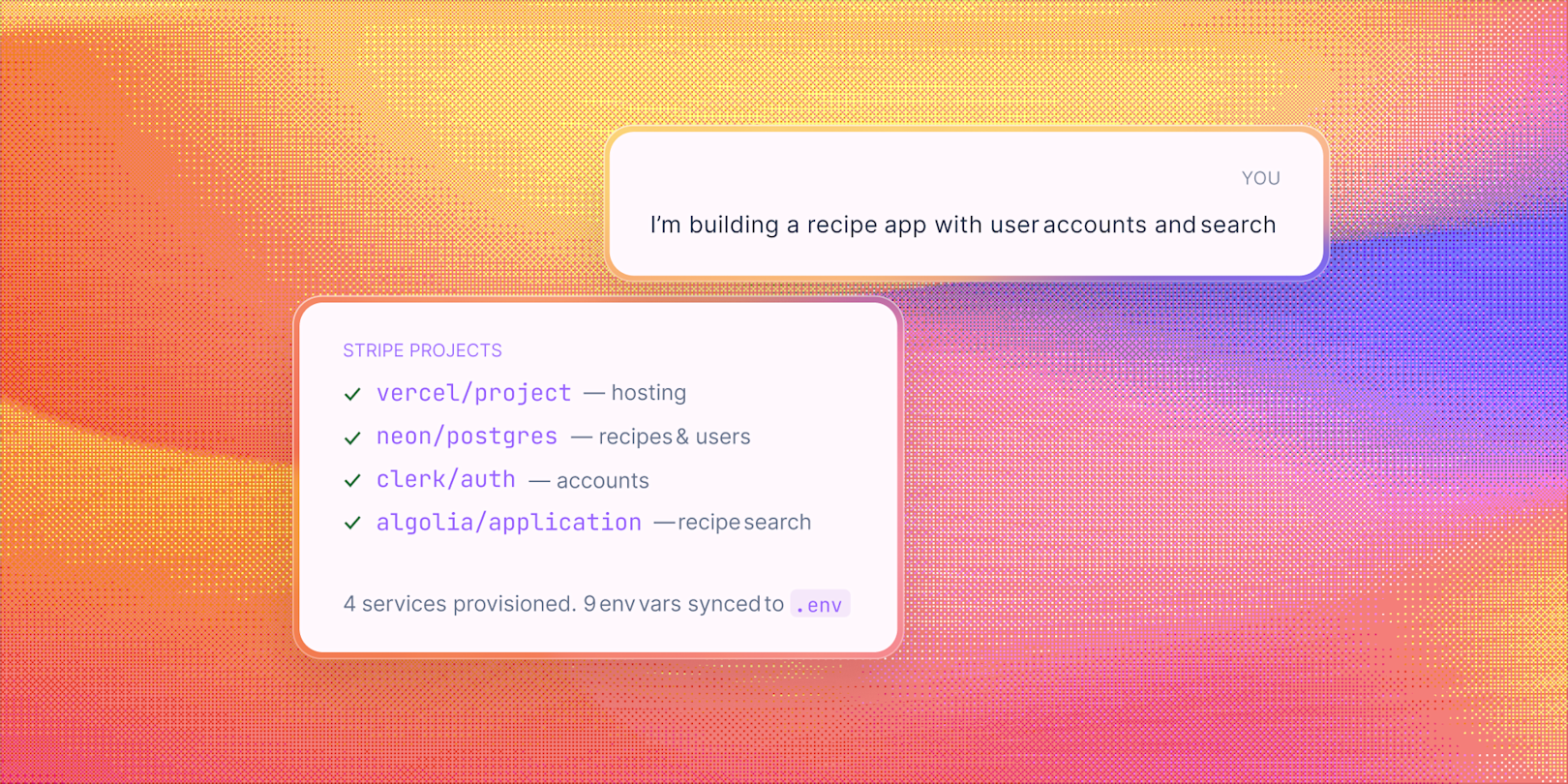
[Factory Droids](https://factory.ai/) and [Warp](https://www.warp.dev/integrations/stripe), model-agnostic coding agents, have also integrated with Projects. Developers can now access the embedded Projects CLI directly in their preferred agent workflows.
## Agents can provision and build with 16 new providers
Stripe Projects now connects to 16 new providers for a total of [49 providers](https://projects.dev/providers). New providers include Metronome, a Stripe product, for usage-based billing, Wix for public-facing storefronts, and ClickHouse for LLM observability. This allows agents to spin up a live AI-powered product, bill users, and monitor model cost, latency, and quality from the first call—without a human clicking through a dashboard.
## Developers can access new controls for agents to safely build
Agents provisioning infrastructure need many of the same guardrails as agents making purchases, such as scoped credentials, spend thresholds, and enforced environment boundaries. We're shipping three updates to give you that control, plus the ability for platforms to natively distribute services for its users.
**See multiple providers' spend in one place.** Stripe Projects now gives you a unified view across all providers by current and historical [cost per project](https://docs.stripe.com/projects#view-your-spend), so you can understand what a project costs to run.
**Set spend limits per provider.** You can now [set custom spending caps per service](https://docs.stripe.com/projects#set-a-spend-limit), such as tighter limits on an AI model provider, or higher limits for production hosting and database layer. Per-provider limits let you tailor the guardrails for each service, helping prevent an agent from burning through your entire budget on a single provider.
**Keep builds contained with named environments.** You can now create [isolated credentials](https://docs.stripe.com/projects#manage-multiple-environments) for development, staging, production, or any custom environment, as well as share resources across environments when you need consistency. Agents default to the development environment, so even if an agent goes off-script, it won't access or impact your production environment.
**Natively provision services on your platform.** With delegated authority and white-labeling support, [platforms can now mint scoped credentials](https://docs.stripe.com/projects/platform-integration) and set up infrastructure on your developers' behalf, so developers can go from writing code to running it without leaving your environment.
## What's next
We'll continue to expand Projects to cover the full lifecycle of agent-built software, from first provision to ongoing operations and security. We plan to add deeper security primitives for agents that act autonomously and a data layer, so providers can meter and bill for the software agents that build on top of their services.
Learn more about [Stripe Projects](https://docs.stripe.com/projects) or, if you're ready to build, ask your agent to: *use Stripe Projects to add a Prisma database.*
## The future of agentic commerce is here
## Agentic Commerce Next: Seattle
June 23, 2026 | 1:00pm - 5:00pm
**The Collective | Alpenglow**
### Prepare for the future of commerce with Stripe
Join Stripe in Seattle on June 23 for a half-day session (1:00 pm-5:00 pm) on how AI is changing commerce and what your team can do now to prepare.
AI-powered discovery is already reshaping how customers find and evaluate products. Agentic purchasing is emerging next. This event is designed to help ecommerce, product, customer experience, and billing leaders understand what matters now across discoverability, catalog readiness, checkout, trust, and fraud.
The afternoon will include a keynote from Microsoft, a panel with leaders from across the ecosystem, guided discussions and hands-on experiences with our partners Klarna, Logicbroker and Orium designed to move attendees from awareness to action.
Attendees will leave with:
- A clearer understanding of what agentic commerce means for their business
- A practical framework for assessing readiness and prioritizing next steps
- Real-world perspectives from Stripe, customers, and ecosystem partners
- Ideas they can apply now across discovery, content, checkout, and risk
### Speakers and Panelists
**1:20 PM - Keynote**
**Billy Conway**
VP of AI Commerce Products - Microsoft
At Sessions 2019, we shared our predictions for the future of payments.
**4:10 PM - Hands on Demos**
We talk to Sothebys, Wayfair, Visa, and Klarna to learn how both incumbent and digital-native enterprises are approaching payments in novel ways.
**John Coy**
Technical Lead, Agentic - WooCommerce
**Jake Sinsheimer**
Head of Agentic Commerce - Stripe
### About the Venue
**The Collective | Alpenglow**
400 Dexter Avenue North
Seattle, WA
Alpenglow is a members-only-style gathering place for people who value connection, creativity, and a beautifully considered experience — part social hub, part event space, entirely its own thing. Think local art, inviting lounge areas, and distinctive touches like the Campfire Circle, hanging egg chairs, Hammock Garden, and bouldering wall. It's the kind of space that feels both elevated and approachable, where every corner has something memorable to discover.
Tucked into a setting designed for engagement and ease, Alpenglow is known for hosting everything from elevated meetings and events to lively socials and culinary experiences. The design speaks for itself — warm, interactive, and genuinely distinctive.
[Learn more.](https://www.invitedclubs.com/clubs/the-collective-seattle)
### Program Overview
**1:15 PM - Welcome and opening remarks**
A brief welcome to frame the day, outline the agenda, and highlight why agentic commerce matters now for teams across ecommerce, product, and customer experience.
**1:20 PM - Featured keynote from Microsoft**
An overview of how AI is beginning to reshape discovery, checkout, trust, and operations—and where businesses should focus first.
**1:55 PM - Panel - Agentic in action: Learnings from the leaders**
A practical discussion with leaders from across the ecosystem on what they're learning as they prepare for agent-led commerce.
**2:45 PM - Guided discussions**
Small-group conversations on the questions that matter most now: discoverability, catalog readiness, checkout, trust, and fraud.
**4:00 PM - Closing remarks and next steps**
A short wrap-up on the day's key takeaways and the practical next steps teams can take from here.
**4:10 PM - Hands-on experiences and networking**
Along with Klarna, Logicbroker and Orium, we'll explore demos, connect with experts, and continue the conversation with peers working through the same challenges.
### Helpful resources
**Survey report: How modern consumers decide and buy**
A new survey of 1,810 shoppers across Australia, France, Germany, Japan, the United Kingdom, and the United States shows a shift in how people choose and purchase. They have new reasons for going in store rather than online, new preferences when it comes to AI involvement, and new expectations for payment methods at checkout. Many retailers are trying to meet these expectations by layering point solutions as needs arise, but this approach can lead to duplicated data, fragmented journeys, and inconsistent checkout experiences. Learn four findings retailers can use now to capitalize on these changing shopper behaviors.
[View](https://go.stripe.global/rs/072-MDK-283/images/How%5Fmodern%5Fconsumers%5Fdecide%5Fand%5Fbuy.pdf)
**Guide: How to sell on AI platforms**
With the launch of in-chat purchasing through interfaces like Instant Checkout in ChatGPT, high-intent shoppers can now buy products directly where they're discovering them. While this provides an opportunity for sellers to monetize a new channel, agentic commerce also challenges one of the basic tenets of ecommerce—that bot traffic is bad—in ways that require sellers to rethink how they handle nearly every aspect of their checkouts. Read this guide to understand some of the most common questions we get about agentic commerce and what we're building to help them succeed.
[View](https://go.stripe.global/rs/072-MDK-283/images/A%5FGuide%5Fto%5Fagentic%5Fcommerce.pdf)
**Guide: The business impact of modern payments**
Transaction fees are only one factor to consider when evaluating payment solutions. A provider with low up-front costs can quickly become a high-cost liability when factoring in fraud losses, unexpected outages, and customer churn. The right payments infrastructure should protect against these costs while creating new revenue streams and reducing operational complexity. Explore how modern payment features can expand market reach, accelerate cash flow, and eliminate inefficiencies that drain your resources.
[View](https://go.stripe.global/rs/072-MDK-283/images/The%5Fbusiness%5Fimpact%5Fof%5Fmodern%5Fpayments.pdf)
**Waitlist: Join the waitlist for agentic commerce**
Businesses interested in selling through AI agents—including OpenAI's Instant Checkout in ChatGPT—can join the waitlist. Stripe is accepting applications from businesses selling through agents, platforms enabling merchants, and AI companies embedding commerce. The program helps companies test new distribution channels and prepare for a future where agent-driven purchasing is mainstream.
[View](https://go.stripe.global/agentic-commerce-contact-sales)
## Rethinking risk in the age of AI
Join senior risk and payments leaders in Seattle to explore how AI is reshaping fraud strategy. Seats are limited.
## New ways to turn global demand into revenue
# New ways to turn global demand into revenue
It's never been easier to reach global customers. Thirty-six percent of Stripe businesses now have customers in more than one country, and the number selling into more than 100 countries has quadrupled in five years. Turning that reach into revenue, however, requires solving a familiar set of cross-border challenges. At Sessions, we announced dozens of new products and capabilities to localize the customer experience, maximize payment performance, move money across borders, and manage tax and regulatory compliance.
## **Convert customers with a localized experience**
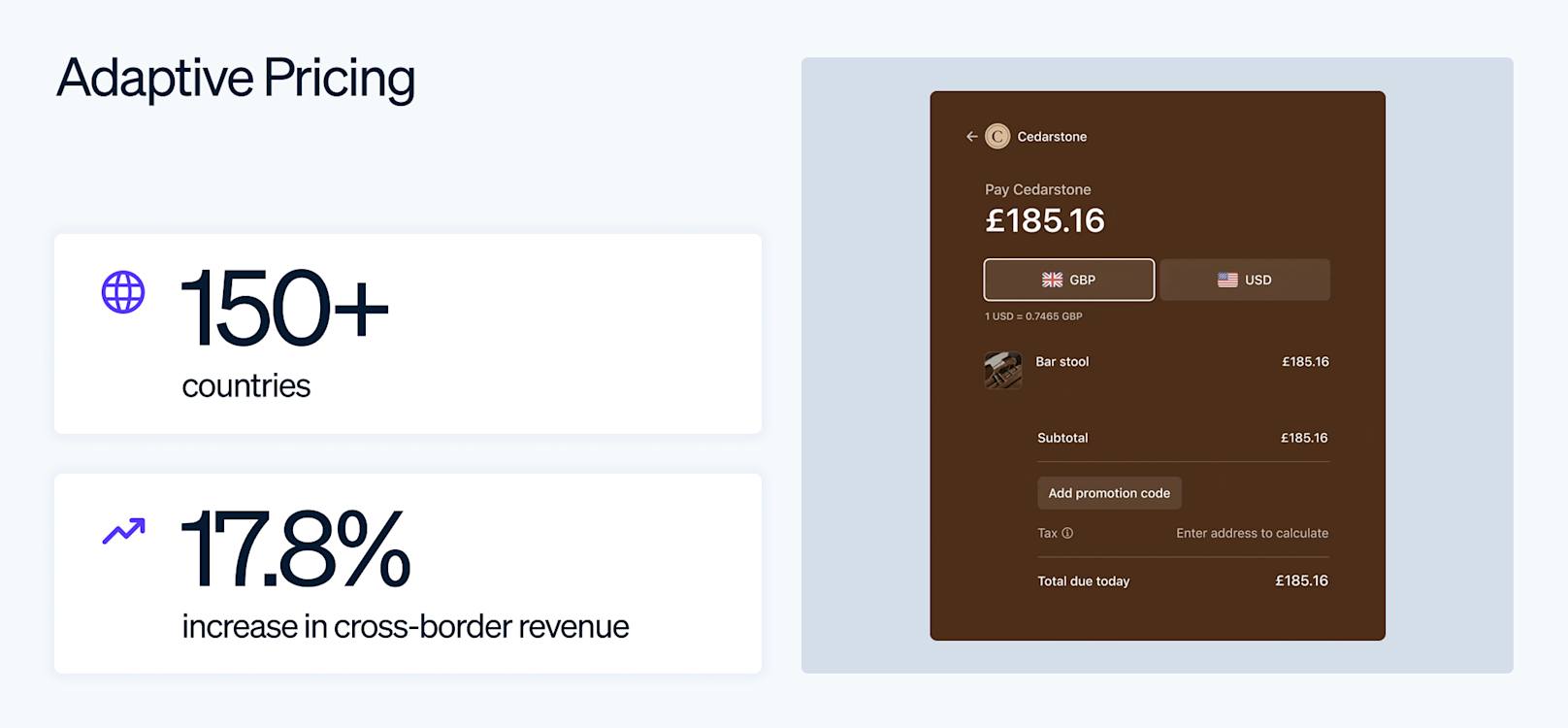
Cross-border success often depends on the customer experience at checkout. A localized experience includes core components like customers' preferred languages, currencies, and payment methods; it also requires continuous optimization.
[Checkout studio](https://docs.stripe.com/payments/checkout-studio), the newest addition to the [Optimized Checkout Suite](https://support.stripe.com/questions/what-is-stripe-s-optimized-checkout-suite-(ocs)), provides tools for businesses to tailor their checkouts to local customers. Industry-specific recommendations and location data help surface local payment methods for each market, with built-in tracking for adoption and performance. Stripe provides access to more than 125 payment methods, including support for [Sunbit](https://docs.stripe.com/payments/sunbit), [Bizum](https://docs.stripe.com/payments/bizum), [Pay by Bank](https://docs.stripe.com/payments/pay-by-bank), [BLIK](https://docs.stripe.com/payments/blik), and [TWINT](https://docs.stripe.com/payments/twint). A fashion retailer expanding into Spain or Poland, for instance, might be prompted in Checkout studio to add Bizum or BLIK and A/B test against live traffic before deploying it live.
Checkout studio provides recommendations to help present the right payment methods. Stripe data shows that even one geographically irrelevant payment method can decrease conversion by up to 15%. The upside of getting it right is significant: on Stripe, businesses offering Pix see up to 38.3% higher conversion from customers in Brazil, and those offering UPI see 19.8% higher conversion from customers in India.
Localization also extends beyond language and payment methods to include pricing in local currencies. Stripe data shows that 76% of customers will choose to pay in their local currency when given the option. [Adaptive Pricing](https://docs.stripe.com/payments/currencies/localize-prices/adaptive-pricing) uses AI to display prices in local currencies, while Stripe handles conversion and the operational work behind it. On average, businesses using Adaptive Pricing see a 5% increase in authorization rates and a 17.8% lift in cross-border revenue.
Adaptive Pricing also supports subscription sign-ups and renewals, with guardrails built in to help keep renewal amounts consistent across billing cycles. On average, [Adaptive Pricing for subscription businesses](https://stripe.com/blog/adaptive-pricing-for-subscriptions) drives a 4.7% conversion uplift and a 5.4% increase in lifetime value (LTV) per session.
## **Increase payment acceptance and reduce fraud in every market**
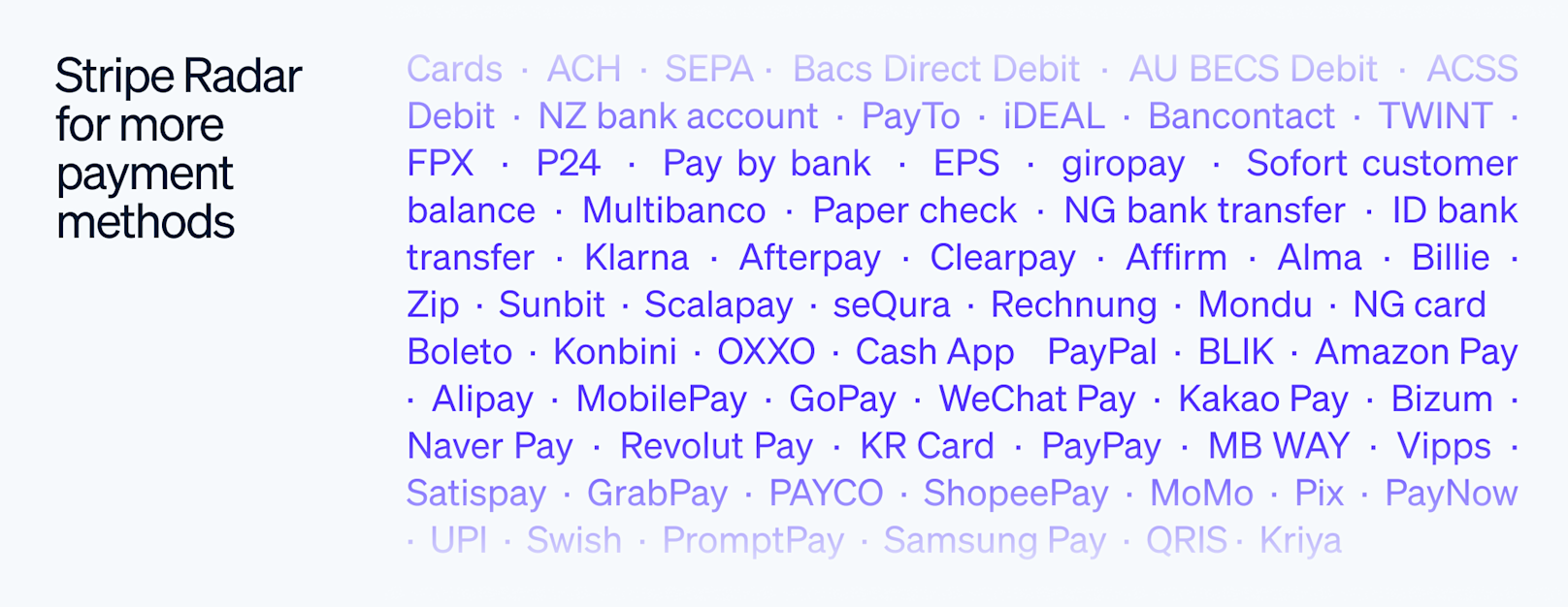
Maximizing payment performance also requires accounting for local nuances. Authorization rates vary across markets due to differences in issuers, local network preferences, and regional card behavior. Stripe helps businesses optimize global payments performance with AI-powered authentication, authorization, and fraud tools.
[Stripe Authorization Boost](https://stripe.com/authorization-boost) adapts to market differences automatically with optimizations like real-time retries and issuer-specific messaging per transaction, and it includes support for [Data Only authentication flows](https://docs.stripe.com/payments/3d-secure/strong-customer-authentication-exemptions#data-only) to reduce payment friction. Together, these capabilities can drive higher acceptance rates and lower processing costs without manual intervention. Businesses see an average 3.8% lift in authorization, and some Stripe customers with custom interchange pricing see processing costs decrease by up to 3.3%. Built-in [A/B testing](https://docs.stripe.com/payments/analytics/optimization/a-b-testing) helps businesses measure impact before fully rolling out changes more broadly.
Adding new markets and payment methods also introduces new fraud vectors. [Stripe Radar helps reduce fraud by](https://stripe.com/radar) automatically blocking high-risk transactions across [all supported payment methods](https://docs.stripe.com/radar/local-payment-methods), including local bank debits; wallets; buy now, pay later options; and stablecoin payments. In a private preview, Stripe data showed that Radar reduced fraud by an average of 71% across four payment methods: Klarna, PayPal, Affirm, and Cash App Pay.
## **Reduce cross-border costs**
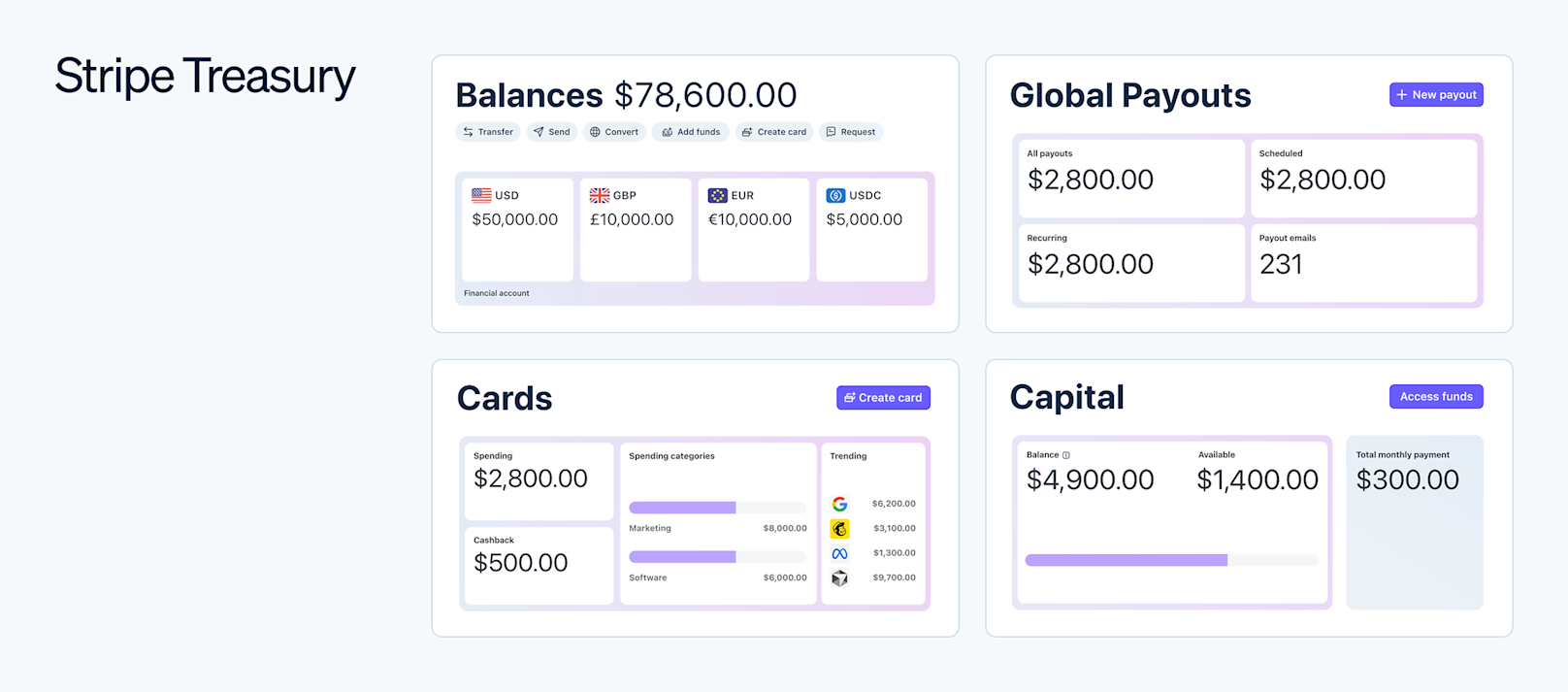
Expanding into more countries can increase revenue, but each new market adds complexity when storing and moving money. Traditional money movement is often fragmented across currencies, accounts, and providers—forcing companies to spend precious time managing operations instead of growing the business.
[Stripe Treasury](https://stripe.com/treasury) brings payments and finances together in one place with the ability to store, convert, and send money across multiple currencies and stablecoins without leaving Stripe. For businesses in the US and UK, settled payment earnings are available instantly, regardless of bank holidays or weekend closures.
Holding funds in multiple currencies has traditionally required multiple bank accounts, local entities, and unnecessary FX fees. With Stripe, businesses can hold [multiple currencies](https://docs.stripe.com/payouts/multicurrency-settlement) side by side in a Treasury account without having to convert them. When [currency conversion](https://docs.stripe.com/instant-currency-conversion) is needed, businesses can do so instantly, 24/7, and lock in transparent, market-leading rates. Organizations can also [pay out globally](https://docs.stripe.com/global-payouts) to more than 160 countries in fiat and stablecoins, and [create cards](https://docs.stripe.com/treasury/cards) that let employees spend directly from Treasury balances.
Additional support for stablecoins gives businesses even more ways to manage and move money globally. A global marketplace, for example, can accept [stablecoin payments](https://docs.stripe.com/payments/stablecoin-payments) in 32 new markets and enable its sellers to hold stablecoins in Treasury. Sellers in 30 countries can also receive a [stablecoin-backed card](https://docs.stripe.com/issuing/stablecoin-cards) and [offramp funds to local currencies](https://apidocs.bridge.xyz/get-started/introduction/what-we-support/payment-routes#supported-fiat-rails) like ARS, COP, EUR, MXN, PHP, and USD.
Today, Treasury is live in more than 120 countries—with stablecoin-backed balances in 100 of them—and we plan to add stablecoin support for an additional 41 countries by the end of 2026. Entrepreneurs in more than 50 countries already use Treasury as their primary business account.
## **Manage tax and regulatory compliance**
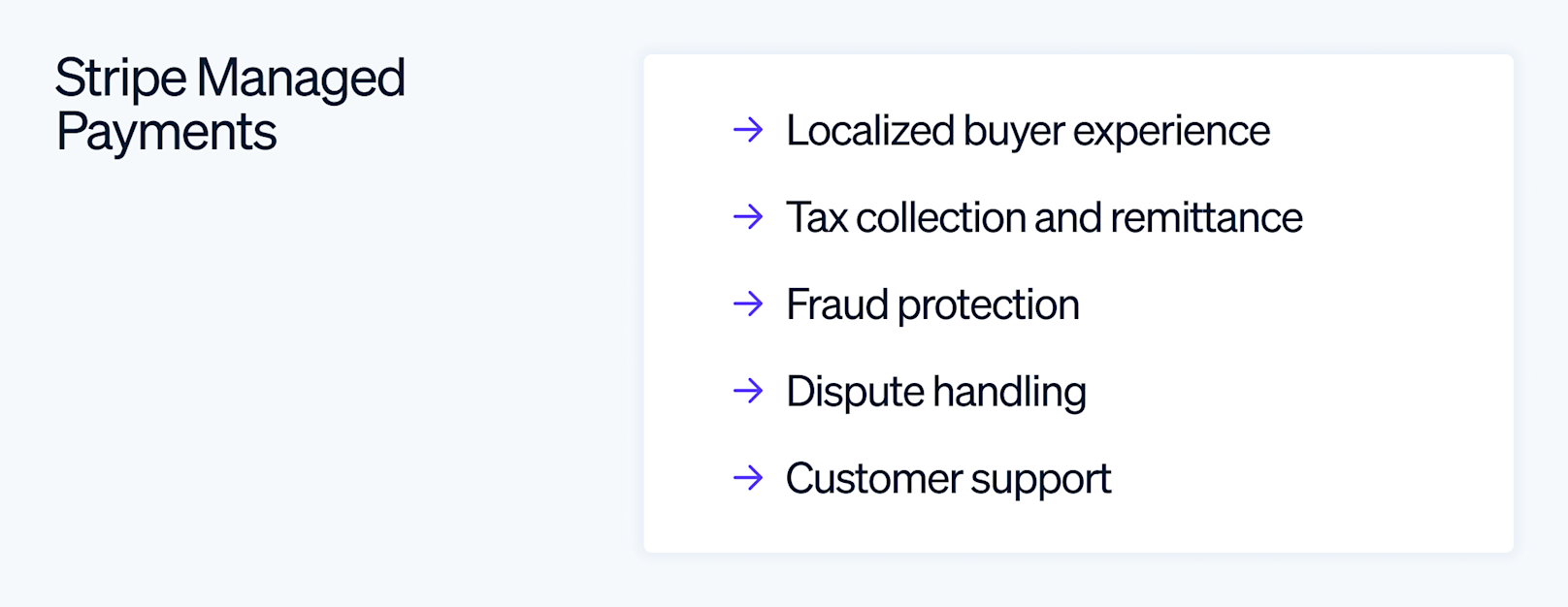
Every market comes with its own tax and regulatory rule book, which can slow global expansion. A business might solve for the roughly 16,000 combinations of US sales tax rates and rules, but expanding into India requires navigating different GST structures, real-time e-invoicing, and dispute windows measured in hours instead of days.
Whether businesses choose to manage compliance themselves with Stripe Tax, or rely on Stripe to handle it through Stripe Managed Payments, both approaches help reduce overhead and make global growth easier.
For businesses that want to remain the merchant of record, [Stripe Tax](https://stripe.com/tax) automates tax calculations, collection, threshold monitoring, registrations, and filing. Stripe Tax automatically calculates and collects the right tax in more than 100 countries across more than 600 product categories to simplify tax compliance as a business grows. OpenAI, [ElevenLabs](https://stripe.com/customers/elevenlabs), and [Retell AI](https://stripe.com/customers/retell-ai) are among more than 67,000 companies using Tax to handle compliance rather than building out a full tax team.
For businesses that want to outsource their tax responsibility, [Managed Payments](https://docs.stripe.com/payments/managed-payments) is Stripe's merchant of record solution. It handles tax registration, collection, and remittance in more than 80 countries, letting businesses focus on their core product, growth, and expansion.
Tax is only part of the challenge of growing globally. Building internal processes for fraud, disputes, and customer support can slow expansion and increase the cost of entering new markets. With Managed Payments, businesses also get fraud protection, dispute management, customer support, and a localized checkout experience. Managed Payments is now available to businesses selling digital goods, and it has already helped companies like Unity, RevenueCat, and Lovable expand.
## **Grow globally, faster**
Whether you're entering your first international market or optimizing for the next 10, Stripe offers solutions to help businesses sell, operate, and grow.
See [everything announced at Sessions 2026](https://stripe.com/blog/everything-we-announced-at-sessions-2026), and check out our [product roadmap](https://stripe.com/roadmap) to see the upcoming features Stripe is planning to help global businesses. To network with industry leaders and explore new paths to growth, sign up for a [Stripe Tour](https://stripetour.com/) event near you.
## Helping businesses optimize network costs with the Visa Digital Commerce Authentication Program (DCAP)
# Helping businesses optimize network costs with the Visa Digital Commerce Authentication Program (DCAP)
[June 3, 2026](/blog/helping-businesses-optimize-network-costs-with-visa-digital-commerce-authentication-program)
[Kanika Nayyar](https://www.linkedin.com/in/kanika-nayyar-/) Global Payments Performance
Visa recently launched the [Digital Commerce Authentication Program (DCAP)](https://support.stripe.com/questions/understand-the-visa-digital-commerce-authentication-program-%28dcap%29-on-stripe), a new global framework designed to reduce fraud and increase authorization rates for card-not-present transactions. The program rewards businesses in the US for sharing richer transaction data with issuers during authentication, such as device ID, billing address, IP address, and customer email. Qualifying transactions receive a net interchange reduction of five basis points.
New network programs create opportunity, but they also introduce complexity. Businesses need to understand which transactions qualify, ensure their integration passes the required data, and determine whether participating will improve their end-to-end transaction economics or have unintended consequences, such as hurting authorization rates.
To participate in DCAP, businesses need to share required cardholder data with issuers via frictionless authentication in their checkout. This might introduce latency and uncertainty around how issuers interpret these newer signals.
We moved quickly to help Stripe businesses take advantage of DCAP and capture interchange savings while protecting authorization rates. Here's what we did.
### Optimizing DCAP savings without sacrificing conversion
Before rolling out DCAP, we worked with Visa to run readiness testing and identify the right implementation approach. This collaborative testing underscored the need for transaction-level intelligence.
With [Stripe Authorization Boost](https://stripe.com/authorization-boost), we intelligently select which transactions should go through [Data Only 3DS](https://docs.stripe.com/payments/3d-secure/strong-customer-authentication-exemptions#data-only), which sends additional risk data from the card network to the issuer for authorization. Rather than applying static rules, Authorization Boost evaluates cost savings, conversion impact, and fraud risk at the individual transaction level to determine when to apply Data Only 3DS. This allows businesses to capture DCAP savings while limiting the impact to the customer experience and optimizing authorization rates.
Since April 18, we've helped Stripe businesses capture $18.4 million in annualized network cost savings from DCAP. By helping businesses collect and pass the required data, we saw an 8x increase in the number of DCAP-eligible transactions. We're continuing to work with Visa to optimize eligibility, so more transactions can benefit from DCAP.
## Automatically benefit from DCAP optimizations
If you use Authorization Boost and are collecting the required data points, you're already automatically benefiting from DCAP optimizations. For businesses using [standalone 3DS](https://docs.stripe.com/payments/3d-secure/standalone-3d-secure), you can participate by setting **flow_preference[type]** to `data_share` on authentication requests and ensuring required fields are populated.
Learn more about how [Authorization Boost](https://docs.stripe.com/payments/analytics/optimization) can help optimize your payments performance.
## Solo founding is at an all-time high: Top performers have these traits in common
In 2025, solo founders in the top decile generated 61 times the revenue of the median solo founder in their first six months. We analyzed the data to understand what drives that gap.
## Expanding Stripe Radar to protect more of your business
Radar now blocks high-risk transactions across all supported payment methods; defends against new fraud types like multi-account abuse and pay-as-you-go abuse, regardless of which payment processor you use; and gives platforms new tools to evaluate and mitigate merchant risk on and off Stripe.
## Five vertical SaaS insights from Sessions 2026
At Stripe Sessions and our inaugural SaaS Platform Leaders Summit, vertical SaaS leaders shared how they’re staying differentiated as AI raises the bar for software. The takeaways: why payments and financial services create moats that AI can’t easily replicate, how platforms are moving from AI experimentation to monetization, and why platforms are expected to lead the way on agentic commerce.
## Everything we announced at Sessions 2026
# Everything we announced at Sessions 2026
This morning at our annual conference, Stripe Sessions, we shared 288 new products and features with more than 9,000 business leaders and builders. We're making Stripe even more programmable; protecting and propelling your business with the strength of the Stripe network; and building economic infrastructure for AI.
Here's everything we announced.
## Payments
Today, we launched and demoed payments infrastructure for the next era of commerce. We expanded the Agentic Commerce Suite through partnerships with Meta and Google; announced a new way to grant agents the ability to pay with Link's agent wallet; and unveiled Checkout studio, which helps you build, analyze, and optimize high-converting checkouts in a few clicks. Here's what's new:
**Agentic commerce**
- You can now sell through AI agents by uploading your product catalog and managing agent access directly from the Stripe Dashboard with the [Agentic Commerce Suite](https://docs.stripe.com/agentic-commerce).
- We previewed the ability for [platforms to use the Agentic Commerce Suite](https://docs.stripe.com/connect/saas/tasks/enable-in-context-selling-on-ai-agents), allowing their connected accounts to become agent-ready with discovery, checkout, payments, and fraud detection handled through a single Stripe integration.
- We partnered with Meta to [enable native checkout inside ads on Facebook](https://stripe.com/newsroom/news/checkout-for-facebook) so discovery and purchase happen in one flow.
- Customers will soon be able to buy your products in AI Mode and the Gemini app via the Universal Commerce Protocol (UCP), through a new partnership between Stripe and Google.
- Agents can now programmatically transact with your business via microtransactions, recurring payments, and more with the [Machine Payments Protocol](https://mpp.dev/) (MPP), co-authored by Stripe and Tempo.
- You can now [accept payments from agents over MPP](https://docs.stripe.com/payments/machine/mpp) in stablecoins as well as fiat through cards, Klarna, and Affirm via [Shared Payment Tokens](https://docs.stripe.com/agentic-commerce/concepts/shared-payment-tokens) (SPTs), using our Payment Intents API.
**Link**
- You can now grant agents the ability to pay with [Link's agent wallet](https://link.com/agents), while maintaining control via spending approvals and full purchase visibility.
- Link now supports additional payment methods. Via Link, US businesses can now accept [Pix](https://docs.stripe.com/payments/link/pix) in Brazil and [stablecoins](https://docs.stripe.com/payments/link/stablecoins). We also previewed the ability for US businesses to accept [UPI](https://docs.stripe.com/payments/link/upi) via Link in India.
- You can now see Link's impact on your conversion, authorization rates, and payments costs in a [dedicated tab in the Dashboard](https://dashboard.stripe.com/link).
**Optimized Checkout Suite**
- We previewed [Checkout studio](https://docs.stripe.com/payments/checkout-studio), a new way for you to configure, analyze, and optimize your checkout with an AI assistant, live transaction replay, A/B testing, and personalized recommendations.
- We previewed Stripe Checkout's new [embedded form](https://docs.stripe.com/checkout/form/quickstart), built for embedded use cases like sidebars, chat boxes, and modals.
- More payment methods, including [Pix](https://docs.stripe.com/payments/pix) and [UPI](https://docs.stripe.com/payments/upi), now support subscriptions, localized currency presentment, and cross-border payments.
- You can now accept [Sunbit](https://docs.stripe.com/payments/sunbit) in the US, [Bizum](https://docs.stripe.com/payments/bizum) in Spain, and [Pay by Bank](https://docs.stripe.com/payments/pay-by-bank) in Finland.
- You can now accept [Bizum](https://docs.stripe.com/payments/bizum), [BLIK](https://docs.stripe.com/payments/blik), and [Pay by Bank](https://docs.stripe.com/payments/pay-by-bank) for cross-border payments.
- You can now accept [TWINT](https://docs.stripe.com/payments/twint) for recurring transactions.
- You can now automatically detect and display your customer's preferred currency with a new [Adaptive Pricing](https://docs.stripe.com/payments/currencies/localize-prices/adaptive-pricing) AI model that analyzes dozens of session signals in real time.
- You can now use [Adaptive Pricing](https://docs.stripe.com/payments/currencies/localize-prices/adaptive-pricing) to localize subscription prices to your customer's domestic currency.
- We previewed a new way for your customers to [save a card in your app by tapping it](https://docs.stripe.com/payments/mobile/embedded-tap-to-add) on their Android device instead of manually entering the card information.
**Stripe Terminal**
- We announced the [Stripe Reader T600](https://stripe.com/terminal/t600), a new countertop device with an eight-inch screen and the power to run custom apps that support experiences like loyalty and upsells.
- We announced the ability to process in-person payments with Terminal in [15 additional markets](https://docs.stripe.com/terminal/payments/collect-card-payment/supported-card-brands), including Hong Kong and Mexico.
- We announced the ability to accept [additional payment methods](https://docs.stripe.com/terminal/payments/collect-card-payment/supported-card-brands#payment-method-availability) such as Alipay, Klarna, and UnionPay International for in-person payments with Terminal.
- We previewed Terminal's [standalone mode](https://docs.stripe.com/terminal/payments/standalone-mode#set-up-standalone-mode), so you can quickly start accepting payments on Stripe readers with no code or point of sale required.
**Stripe Managed Payments**
- All digital businesses can now use [Managed Payments](https://docs.stripe.com/payments/managed-payments), Stripe's merchant of record solution. It helps digital businesses sell globally by handling indirect tax compliance in 80+ countries, as well as fraud prevention, dispute management, and customer support.
**Payments Intelligence Suite**
- We previewed the ability to [A/B test Authorization Boost](https://docs.stripe.com/payments/analytics/optimization/a-b-testing) against your existing payments performance.
- You can now use Authorization Boost's new AI-powered optimizations, including support for [Data Only authentication flows](https://docs.stripe.com/payments/3d-secure/strong-customer-authentication-exemptions#data-only) and [PINless debit retries](https://docs.stripe.com/payments/analytics/optimization#adaptive-acceptance), helping increase acceptance rates by an average of 3.8% and lower processing costs by up to 3.3%.
- You can now use Stripe's 3DS solution on a [standalone basis](https://docs.stripe.com/payments/3d-secure/standalone-three-d-secure)—enabling regulatory compliance, including support for exemptions, and fraud protection to payments processed by another payment service provider.
- You can now use the [Stripe Dashboard assistant](https://docs.stripe.com/assistant) for payments analytics, which investigates performance issues, diagnoses root causes, and recommends next steps in natural language.
## Radar
Millions of global businesses use Stripe Radar to fight fraud, from leading AI companies like OpenAI, Anthropic, ElevenLabs, and Cursor to global enterprises like PepsiCo and Hertz. Today, we announced the biggest-ever upgrades to Radar, helping you to defend against new types of fraud—including token abuse and account fraud—protect more of your payments on and off Stripe, and win more disputes. Here's what's new:
- You can now identify high-risk trials without blocking legitimate customers using [Radar's free trial abuse prevention](https://docs.stripe.com/radar/free-trial-abuse).
- We previewed [Radar's bot abuse prevention](https://docs.stripe.com/radar/bot-abuse), designed to accurately distinguish legitimate AI agents from fraudulent actors.
- You can now use a new payment signal to identify [fraudulent payments](https://docs.stripe.com/radar/multiprocessor#fraudulent-payment) on and off Stripe with [Stripe Signals](https://docs.stripe.com/signals).
- We previewed additional payment signals to [predict disputes](https://docs.stripe.com/radar/multiprocessor#fraudulent-dispute) and [early fraud warnings](https://docs.stripe.com/radar/multiprocessor#early-fraud-warning), and detect [pay-as-you-go abuse](https://docs.stripe.com/radar/pay-as-you-go-abuse) before invoices go unpaid with [Signals](https://docs.stripe.com/signals).
- We previewed new customer signals to detect [multi-account abuse](https://docs.stripe.com/radar/multi-account-and-account-sharing-abuse#multi-account-abuse) and [account sharing abuse](https://docs.stripe.com/radar/multi-account-and-account-sharing-abuse#account-sharing-abuse) with [Signals](https://docs.stripe.com/signals), helping you distinguish real customers from bad actors before they cost you money.
- We previewed new merchant signals to assess [fraud risk for new accounts](https://docs.stripe.com/radar/fraudulent-merchant), predict [merchant delinquency](https://docs.stripe.com/radar/merchant-delinquency-risk), and analyze [websites for suspicious activity](https://docs.stripe.com/radar/fraudulent-website) using LLM-powered reviews with [Signals](https://docs.stripe.com/signals).
- We previewed new Stripe Issuing authorization signals that predict the likelihood that a [card authorization is fraudulent](https://docs.stripe.com/radar/issuing-authorization-evaluation), extending protection to non-Stripe issuers, banks, and fintechs.
- You can now use Radar's fraud protection to block high-risk transactions on [all supported payment methods](https://docs.stripe.com/radar/local-payment-methods), including bank debits; wallets; buy now, pay later (BNPL) options; and stablecoins.
- We announced [custom Radar models](https://docs.stripe.com/radar/custom-fraud-models) that are trained on your business signals along with Stripe's global network intelligence for more accurate fraud detection.
- You can now access [upgraded fraud intervention models for Checkout](https://docs.stripe.com/payments/checkout/how-checkout-works?payment-ui=stripe-hosted#manage-risk) that enable precise, low-friction interventions, such as targeted CAPTCHAs, to reduce fraud while improving conversion.
- You can now receive [AI-powered recommendations](https://docs.stripe.com/disputes/set-up-smart-disputes#provide-more-data-at-dispute-time) for additional evidence fields, such as tracking number or customer usage logs, to supplement Smart Disputes evidence.
- You can now store persistent documentation, like terms and conditions, in your evidence library. [Smart Disputes](https://docs.stripe.com/disputes/set-up-smart-disputes) can pull from this library automatically, so you don't have to submit the same materials repeatedly.
## Revenue
Agentic activity requires new, real-time infrastructure for metering, rating, alerting, and payments. We upgraded our Revenue suite to support new AI-native business models with dimensional pricing and streaming payments. We also made Stripe more programmable with three new Stripe Billing customizations and expanded access to real-time, ready-to-query data. Here's what's new:
**Stripe Billing**
- You can now power a broader range of [usage-based and hybrid pricing models](https://docs.stripe.com/billing/subscriptions/usage-based) with Metronome, a Stripe product. You can manage commits, multidimensional pricing structures, bespoke contracts, and more, with real-time revenue visibility down to the account, contract, and product level.
- You can now access and manage Metronome contracts, customers, and data directly in the Stripe Dashboard with the [Metronome app](https://docs.metronome.com/guides/get-started/stripe-marketplace-app).
- We announced the ability to support streaming payments by combining [Metronome](https://docs.metronome.com/guides/customers-billing/set-up-notifications/streaming-alerts) and [Tempo](https://docs.tempo.xyz/guide/machine-payments/streamed-payments), allowing you to get paid the instant value is delivered and cost incurred.
- You can now [track credit balances](https://docs.stripe.com/billing/usage-based) at industry-leading rates, [get instant low-balance alerts](https://docs.stripe.com/billing/usage-based), and [configure automatic credit top-ups](https://docs.stripe.com/billing/usage-based).
- We previewed support for [three new types of Billing customizations](https://docs.stripe.com/billing/scripts), allowing you to programmatically define how subscription items appear on invoices, how prorations behave, and how balances and credits are applied.
- We previewed [payment plans](https://docs.stripe.com/invoicing/payment-plans) that you can use to accept installment payments with automated collection, giving your customers more flexibility and improving cash flow.
- We previewed [subscription invoice revisions](https://docs.stripe.com/invoicing/invoice-edits), so you can edit finalized subscription invoices and automatically void the original invoice.
**Stripe Tax**
- You can now [automate US tax filing](https://docs.stripe.com/tax/file-with-taxjar), track status, and view filing details in the Stripe Dashboard, powered by TaxJar.
- We previewed additional Stripe Tax Connectors for [Shopify](https://docs.stripe.com/use-stripe-apps/shopify) and [NetSuite](https://marketplace.stripe.com/apps/paypack), so you can extend Tax to platforms where you already do business.
- We previewed the ability for Tax to [verify tax IDs](https://docs.stripe.com/payments/advanced/tax?api-integration=checkout#real-time-tax-id-validation) against government databases during checkout flows, blocking invalid IDs.
- Payment Intents API users can now calculate and record tax on a payment [with a single parameter](https://docs.stripe.com/tax/payment-intent)—no separate API calls required.
- Businesses located in Liechtenstein and Mexico and digital sellers in Sri Lanka can now [use Tax](https://docs.stripe.com/tax/supported-countries). We will also offer full support for businesses in Malaysia and remote sellers in French and Spanish territories soon.
**Data**
- We previewed the ability to retrieve real-time subscription metrics within AI agents using the [Stripe MCP](https://docs.stripe.com/mcp), or within [Stripe Console](https://docs.stripe.com/dashboard/console).
- We previewed [Stripe Database](https://docs.stripe.com/stripe-data/stripe-database), giving you real-time Stripe data in a managed, hosted, read-only Postgres database. You can spin up the database with one click from the Dashboard or a single CLI command, allowing you to build and ship applications faster.
- We previewed the [next generation of Stripe Data Pipeline](https://docs.stripe.com/stripe-data/data-pipeline-next-gen), enabling real-time data syncs to Google Sheets with more data destinations coming soon.
- You can now sync all of your Stripe data directly to [Databricks](https://docs.stripe.com/stripe-data/access-data-in-warehouse/data-warehouses) with Data Pipeline.
- We previewed the ability for you to programmatically retrieve prebuilt financial reports across accounts in your organization using the [Reports API v2](https://docs.stripe.com/reports/v2-api).
- We previewed the ability for businesses using Stripe Sigma to execute custom SQL queries programmatically for advanced data modeling and reporting with the [Reports API v2](https://docs.stripe.com/reports/query-runs).
## Money Management
The AI economy is growing at breakneck speed, and more companies have a global footprint from day one. But the tools to manage your money haven't kept up, with finances typically scattered across half a dozen apps and spreadsheets. We previewed new capabilities to help you store, spend, and manage money—including a Stripe card that rewards you for spending, free transfers to other Stripe Treasury users, and MCP support for Treasury APIs so you can build your own financial agents. Here's what's new:
**Stripe Atlas**
- We announced the ability for Atlas founders to track and receive [SAFE](https://docs.stripe.com/atlas/fundraise-with-safes) funding from investors via ACH, wire transfer, or stablecoin transfer with a Treasury financial account.
**Stripe Treasury**
- We announced that for US and UK businesses, Treasury will [support storage in 15 currencies](https://docs.stripe.com/treasury#request-access) by the end of the year.
- You can now [instantly transfer funds](https://docs.stripe.com/treasury#send-instant-transfers-to-stripe-profiles) between US businesses on Stripe for free.
- US users can now spend their settled Stripe earnings with a [Stripe card](https://docs.stripe.com/treasury/cards) powered by Mastercard, with 2% [cashback](https://docs.stripe.com/treasury/cards#get-cashback-rewards) on purchases.
- We announced that Treasury balances in the US will [earn Stripe credits](https://docs.stripe.com/treasury#request-access) that you can apply toward your processing fees.
- You can now see a full view of balances, transactions, cards, and spending directly from your phone with the new [mobile experience](https://docs.stripe.com/treasury#mobile-app) for Treasury within the Stripe app.
- We announced that [Treasury](https://docs.stripe.com/treasury) will be available in Australia and Canada by the end of the year. We will also add stablecoin support for an [additional 41 markets](https://docs.stripe.com/treasury#request-access).
- We announced that Treasury balances will soon be [backed by noncustodial wallets](https://docs.stripe.com/treasury/stablecoins#request-access-privy) from Privy, enabling businesses in more than 150 markets to instantly move money across borders.
- We announced [agent-ready financial accounts](https://docs.stripe.com/mcp#request-access-agentic-treasury) that enable agents to check balances, pay invoices, store funds, create cards, send money, and manage cash flow—with human-in-the-loop confirmation for key actions.
**Stripe Global Payouts**
- We previewed expanded [Global Payouts](https://docs.stripe.com/global-payouts) coverage, so you can send payouts to recipients in more than 100 countries in fiat and 160 countries in stablecoins.
- We previewed the ability for Global Payouts users to send [USD payouts to Link users](https://docs.stripe.com/global-payouts/send-money/link) instantly.
## Embedded Finance
Stripe Connect powers more than 16,000 platforms, including Shopify, DoorDash, and Substack, which collectively help 11 million businesses accept payments. Today, we shared new ways to help platforms grow as AI reshapes software, including a new growth studio that uses Stripe data to surface actionable recommendations and the ability to launch new revenue streams through Treasury and Stripe Capital. Here's what's new:
**Stripe Connect**
- We previewed the [platform growth studio](https://docs.stripe.com/connect/dashboard/grow-your-connect-business), which generates recommendations directly in the Dashboard to help you expand your product offerings and grow faster. It includes AI-powered margin optimization recommendations, peer benchmarking, and no-code promotional pricing campaigns for local payment methods and Instant Payouts.
- [Network cost passthrough](https://docs.stripe.com/connect/network-cost-passthrough-platforms) (IC++) is now available to platforms in 45 markets, including the US, Canada, UK, and EU. You can now enable IC+ pricing and prebuilt reports for your connected accounts directly in the Dashboard.
- We previewed [new embedded components](https://docs.stripe.com/connect/supported-embedded-components) for your connected accounts to order Terminal hardware, scan checks, view business performance charts, and access balance or payout reconciliation reports.
- We previewed the ability for you to use [Stripe Managed Risk via API](https://docs.stripe.com/connect/risk-management/api-managed-risk), allowing platforms and banks to outsource risk management to Stripe while maintaining full control over the user experience.
- Platforms will soon be able to launch full-scale financial services with less operational overhead using [Managed Risk for Treasury](https://docs.stripe.com/treasury/connect/v2/account-management/prebuilt-embedded-finance).
- [Platforms can now use Smart Disputes](https://docs.stripe.com/disputes/smart-disputes/auto-respond#for-connect-platforms) to automatically compile and submit dispute evidence on behalf of their connected accounts.
- [Platforms can now mitigate risk](https://docs.stripe.com/radar/radar-for-platforms) across their business with Radar, featuring 0-to-100 fraud scores for every business and transaction, AI-powered insights that explain why accounts are flagged, and a comprehensive view of account activity.
- Your connected accounts can now onboard onto your platform in one click with [networked onboarding](https://docs.stripe.com/connect/networked-onboarding). We also previewed support for Link wallet users to onboard in one click, even if they don't already have a Stripe account.
- Marketplaces in the US, UK, European Economic Area (EEA), and Canada can now programmatically pay out funds to sellers' connected accounts across any of these regions with [cross-border payouts](https://docs.stripe.com/connect/cross-border-payouts).
- We previewed the ability for marketplaces that sell in Europe to continue using multiple payment providers while making [unified payouts through Stripe](https://docs.stripe.com/connect/multiprocessor-payouts-marketplaces). This will help marketplaces comply with upcoming PSD3 regulations without disrupting their multiprocessor setups.
- We previewed [wallets](https://docs.stripe.com/treasury/connect/consumers) for marketplace sellers to receive earnings, hold funds, and make on-marketplace purchases using their financial account balance.
- We previewed the ability for marketplaces to allow both sellers and customers to spend their financial account balance on the marketplace and other businesses by [issuing prepaid debit cards](https://docs.stripe.com/treasury/connect/consumers).
- We previewed how we will use stablecoin rails to allow Connect marketplaces to instantly [transfer funds to sellers](https://docs.stripe.com/connect/cross-border-payouts) in 100 additional countries.
**Stripe Treasury for platforms**
- You will soon be able to offer Treasury and spend cards for your users in just a few lines of code with [embedded components](https://docs.stripe.com/treasury/connect/v2/account-management/prebuilt-embedded-finance).
- We previewed several new features available through [Treasury for platforms](https://docs.stripe.com/treasury/connect), including bill pay, automated cash rewards, cash acceptance, check acceptance, real-time payments, and accounting integrations.
**Stripe Capital for platforms**
- You can now offer Capital to [your connected accounts in France and Germany](https://docs.stripe.com/capital/how-stripe-capital-works), with Australia and Canada coming soon.
- We previewed [lines of credit](https://support.stripe.com/questions/stripe-capital-line-of-credit-faq), so your connected accounts can draw funds repeatedly as needed, up to an approved amount.
- We previewed the ability for platforms to [underwrite a business with no Stripe payment processing history](https://docs.stripe.com/capital/import-non-stripe-data) through Capital, allowing them to receive capital and onboard to Stripe Payments in one unified flow.
**Stripe Issuing**
- We previewed [Issuing for agents](https://docs.stripe.com/issuing/agents), which allows businesses and agentic platforms to programmatically issue single-use virtual cards, so agents can make purchases and manage financial workflows autonomously.
- We previewed the ability to [launch a live card program for humans and agents](https://docs.stripe.com/issuing/for-your-business) in minutes, with self-serve onboarding, prebuilt program templates, and live funds.
- We previewed [consumer debit issuing](https://docs.stripe.com/issuing/consumer-prepaid-debit-cards), so you can offer prepaid rewards cards, disbursements, and branded cards.
## Stablecoins and Crypto
Stablecoins and crypto are helping you move money faster and more affordably around the world. We introduced a new primitive from Privy to manage multichain balances with one simple API, expanded Bridge's Open Issuance so businesses can launch and manage their own stablecoins, and launched stablecoin-backed cards for recipients to spend funds locally or globally. Here's what's new:
- You can now [accept stablecoin payments](https://docs.stripe.com/payments/stablecoin-payments) in 32 additional markets.
- We previewed the ability for US businesses to use Stripe Crypto Onramp to support [headless implementations on web and mobile](https://docs.stripe.com/crypto/onramp/embedded-components-integration-guide), custom stablecoins issued through Open Issuance, and a separate [KYC mode](https://docs.stripe.com/crypto/onramp/kyc-integration-guide) on transactions up to $500.
- You can now enable [consumer or commercial stablecoin-backed cards](https://docs.stripe.com/issuing/stablecoin-cards) in 30 countries, enabling recipients to spend their funds locally or globally.
- Via Bridge, you can now [onramp and offramp](https://apidocs.bridge.xyz/get-started/introduction/what-we-support/payment-routes#supported-fiat-rails) in COP and GBP, in addition to USD, BRL, EUR, and MXN.
- Via Bridge, you can now move and hold [USDG and Bridge-issued stablecoins](https://apidocs.bridge.xyz/get-started/introduction/what-we-support/payment-routes#route-explorer), including CASH, USDSui, and USDCBL.
- Via Bridge, you can move money across additional [blockchains](https://apidocs.bridge.xyz/get-started/introduction/what-we-support/payment-routes#route-explorer), including Tempo, Plasma, Celo, and Sui.
- Your customers can now hold, move, and grow stablecoin balances anywhere in the world with [Privy digital asset accounts](https://docs.privy.io/wallets/accounts/overview#digital-asset-accounts).
- We announced [flexible custody via Privy](https://docs.privy.io/wallets/overview/flexible-custody#flexible-custody), allowing you to configure wallets on a wallet-by-wallet basis with both custodial and self-custodial options for global reach.
- Via Privy, you can now [provision custodial wallets](https://docs.privy.io/wallets/custodial-wallets/overview) operated with a licensed custodian of your choice.
- Via Privy, you can now [earn on idle balances](https://docs.privy.io/transaction-management/overview#earn) by connecting them directly to curated DeFi vaults on Morpho.
- Via Privy, you can now [provision wallets for agents directly from the command line](https://docs.privy.io/recipes/agent-integrations/agent-cli#agent-cli) and track their spending through an agent-managed dashboard.
- Via Privy, you can now use an API integration with Bridge for [bank transfer onramp and offramp flows](https://docs.privy.io/recipes/bridge-onramp).
- Via Privy, you can now [enable AI agents to invest and transact securely with programmable wallets](https://docs.privy.io/recipes/agent-integrations/agentic-wallets#agentic-wallets), including trigger-based micropayments and buy, sell, and hold crypto for investment use cases.
## Stripe Platform
As agents become a foundational part of how developers build and operate on Stripe, we're investing in three areas: making Stripe extensible and programmable with primitives like custom objects; giving agents reliable tools for building, integrating, and operating on Stripe; and introducing new agentic surfaces to help you analyze and act on your Stripe data. Here's what's new:
- We previewed [Stripe Console](https://docs.stripe.com/dashboard/console), an agentic execution environment built directly into the Dashboard. Ask a business question in plain language and Console returns a structured diagnosis drawn from across your Stripe products. Or, give Console a Stripe-related task, and it will carry it out, asking for confirmation before taking consequential actions.
- AI partners and developer platforms can now use the [Claimable Sandboxes API](https://docs.stripe.com/sandboxes/claimable-sandboxes) to embed Stripe into their platforms. We've also added more test data, including product catalogs, that you can push to your live Stripe account.
- We previewed the ability to securely create and pass live API keys to your platform on behalf of your users with [automated key exchanges](https://docs.stripe.com/stripe-apps/api-authentication/managed-api-keys) from Stripe's claimable sandboxes.
- We previewed [custom objects](https://docs.stripe.com/custom-objects), so you can model your business data and logic inside Stripe. You can define, store, and manage custom objects with typed fields, relationships, methods, and the same APIs and operational controls as native Stripe resources.
- [Stripe Workflows](https://docs.stripe.com/workflows) is now generally available. We also previewed new features, including looping, third-party custom actions, prebuilt actions for Mailchimp and Slack, programmatic invocation, and support for Connect.
- We previewed the ability for app developers to [build full-page, multitab experiences](https://docs.stripe.com/stripe-apps/patterns/full-page-apps) inside the Stripe Dashboard.
- You can now provision, manage, and bill for your entire dev stack—including hosting, databases, authentication, observability, analytics, and AI—with [Stripe Projects](https://docs.stripe.com/projects).
- We previewed the ability to [set up agent guardrails in Stripe](https://docs.stripe.com/account/approvals) to assign agent identities, enforce scope rules, and configure approval flows for sensitive actions.
## What's coming later this year
Today, we launched [our public roadmap](https://stripe.com/roadmap): an itemized list with hundreds of detailed entries through Q1 2027, covering products, features, and improvements across Payments, Revenue, Money Management, and beyond. While it's extensive, it's noncomprehensive—we're moving at breakneck speed, so you'll see us ship even more things that aren't on the roadmap, too.
Here's what you can expect:
### Payments
[Agentic commerce](https://stripe.com/shipped?product=Agentic+Commerce)
- **\[Q2, public preview\]** Agents can initiate payments using a customer's permitted payment method, without exposing the underlying credentials.
[Link](https://stripe.com/roadmap?product=Link)
- **\[Q2, GA\]** A native Link app for iOS and Android gives buyers a single place to manage payment methods, view transaction history, and automate purchases with configurable alerts.
[Payment processing](https://stripe.com/roadmap?product=Payment+processing)
- **\[Q2, GA\]** Route Apple Pay payments through the local eftpos network in Australia.
- **\[Q2, GA\]** Accept Satispay for cross-border payments.
- **\[Q2, GA\]** Accept Scalapay, an Italian buy now, pay later method, for cross-border and domestic payments.
- **\[Q2, GA\]** Legal CBD businesses can use Stripe.
- **\[Q2, public preview\]** Integrate Stripe Payments directly into Aptos ONE workflows.
- **\[Q3, public preview\]** Use an off-session payments API for transactions you initiate.
- **\[Q3, public preview\]** Build session-based payment flows that bill at the granularity of usage events like token consumption and API invocations.
- **\[Q3, GA\]** Dating service businesses can use Stripe.
- **\[Q4, GA\]** Convert 13+ currencies instantly in your Stripe Payments balance—from the Dashboard or via API—in 35 markets including the US, UK, EU, CH, SG, HK, AU, and NZ.
[Stripe Terminal](https://stripe.com/roadmap?product=Terminal)
- **\[Q4, public preview\]** Stripe Terminal supports dynamic currency conversion to present pricing in the customer's local currency.
- **\[Q4, GA\]** Stripe Terminal supports multicapture, so merchants can partially capture an authorized payment multiple times.
- **\[Q4, public preview\]** Use Tap to Pay on Android in Japan.
[Stripe Financial Connections](https://stripe.com/roadmap?product=Financial+Connections)
- **\[Q2, private preview\]** Use
## Giving agents the ability to pay
# Giving agents the ability to pay
In the [Sessions keynote](https://stripe.com/blog/everything-we-announced-at-sessions-2026), we talked about how agents are becoming active participants in the internet economy, and how we're building the infrastructure to support them.
Agents have become increasingly capable in recent months, but making purchases across the internet remains difficult. While [machine payments protocols](https://stripe.com/blog/machine-payments-protocol) are still gaining adoption, agents need to work with the payment options sellers and consumers use today.
Today we're launching [Link](https://link.com/)'s wallet for agents, built on top of Stripe's new Issuing for agents. You can now give agents programmatic access to Link and the ability to get a one-time-use card or a [Shared Payment Token](https://docs.stripe.com/agentic-commerce/concepts/shared-payment-tokens) (SPT), backed by the cards and bank accounts already in your wallet. The agent never gets access to your raw payment credentials.
You can review and approve each spend request from the agent on the web, or in Link's new [iOS](https://apps.apple.com/us/app/link-a-smarter-wallet/id1623228342) and [Android](https://play.google.com/store/apps/details?id=com.stripe.link.android) apps. This makes it easy for consumers to enable personal AI agents such as OpenClaw to make an authorized purchase on their behalf.
If you're a developer or business building consumer-facing agents, such as personal assistants, Link's wallet for agents removes the need to build wallet infrastructure from scratch. Link handles the abstraction across payment options your agent might need—like cards and SPTs (with stablecoins and other payment methods coming soon). It also takes care of fund flow complexity and helps you reach Link's customer base of more than 200 million consumers.
## How Link's wallet for agents works
Imagine you are building a shopping agent that recommends apparel to your consumers. First, the consumer grants your agent access to their Link wallet via a standard OAuth flow.
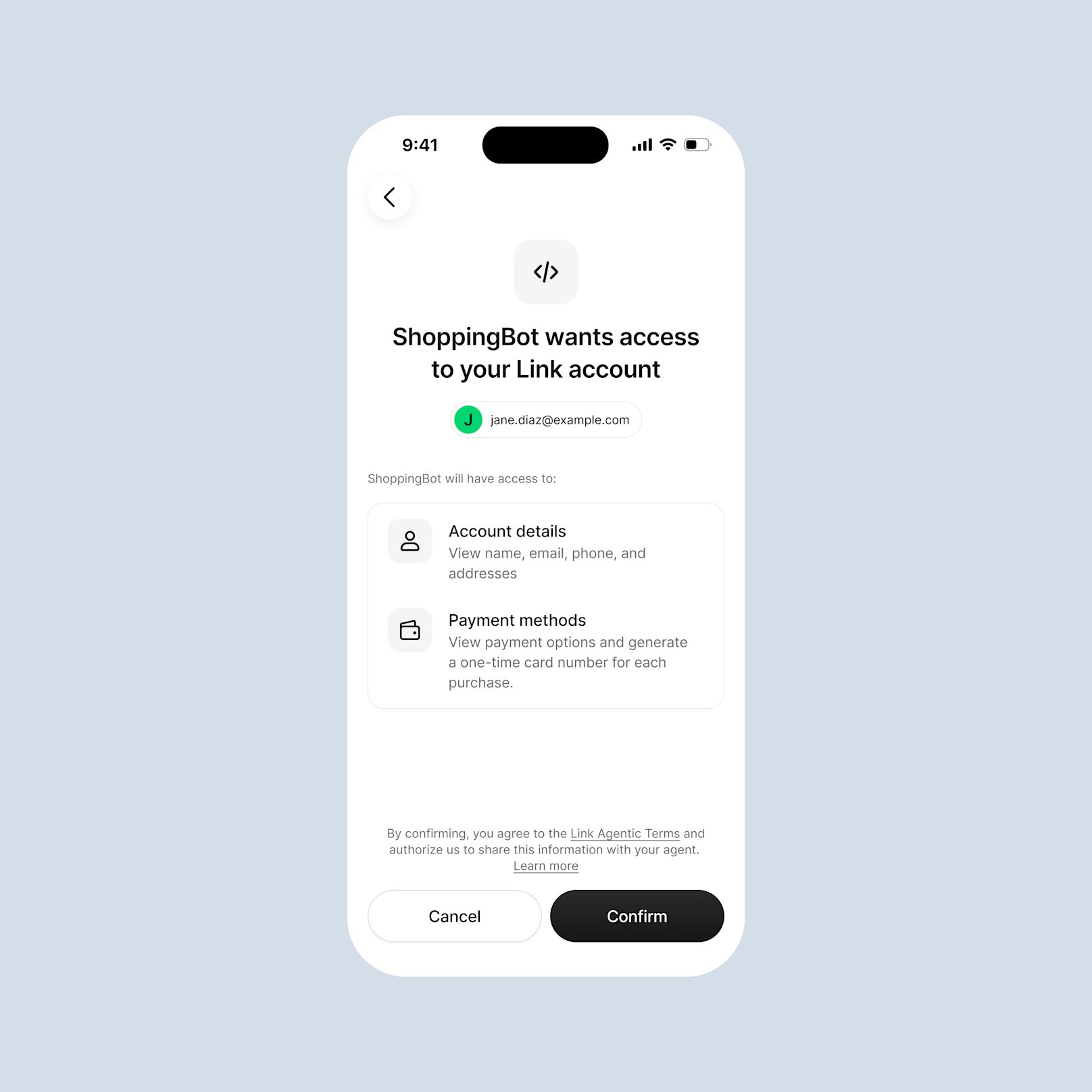
Once your agent has access, it can create a spend request to get either a one-time-use card or an SPT to complete the transaction. Your agent provides context on the transaction, so the person can understand and approve the request. In both card and machine-native flows, the payment credential can be scoped with controls like amount, currency, and merchant. Support for agentic tokens, stablecoins, and other payment types are coming soon.
```
link-cli spend-request create \
payment-method-id csmrpd_12345 \
merchant-name "Powdur" \
merchant-url "https://powdur.com" \
amount 3500 \
context "Purchasing the Powdur Glow Renewal Vitamin C Serum as a gift for $35." \
request-approval
```
The consumer gets a notification and approves the spend request in Link (on the web, or in the Link [iOS](https://apps.apple.com/us/app/link-a-smarter-wallet/id1623228342) or [Android](https://play.google.com/store/apps/details?id=com.stripe.link.android) app). Today, each request requires the person's review before the credential is shared with your agent. We're planning on expanding these controls to let people set spending limits, and choose when agents can act without additional approval.
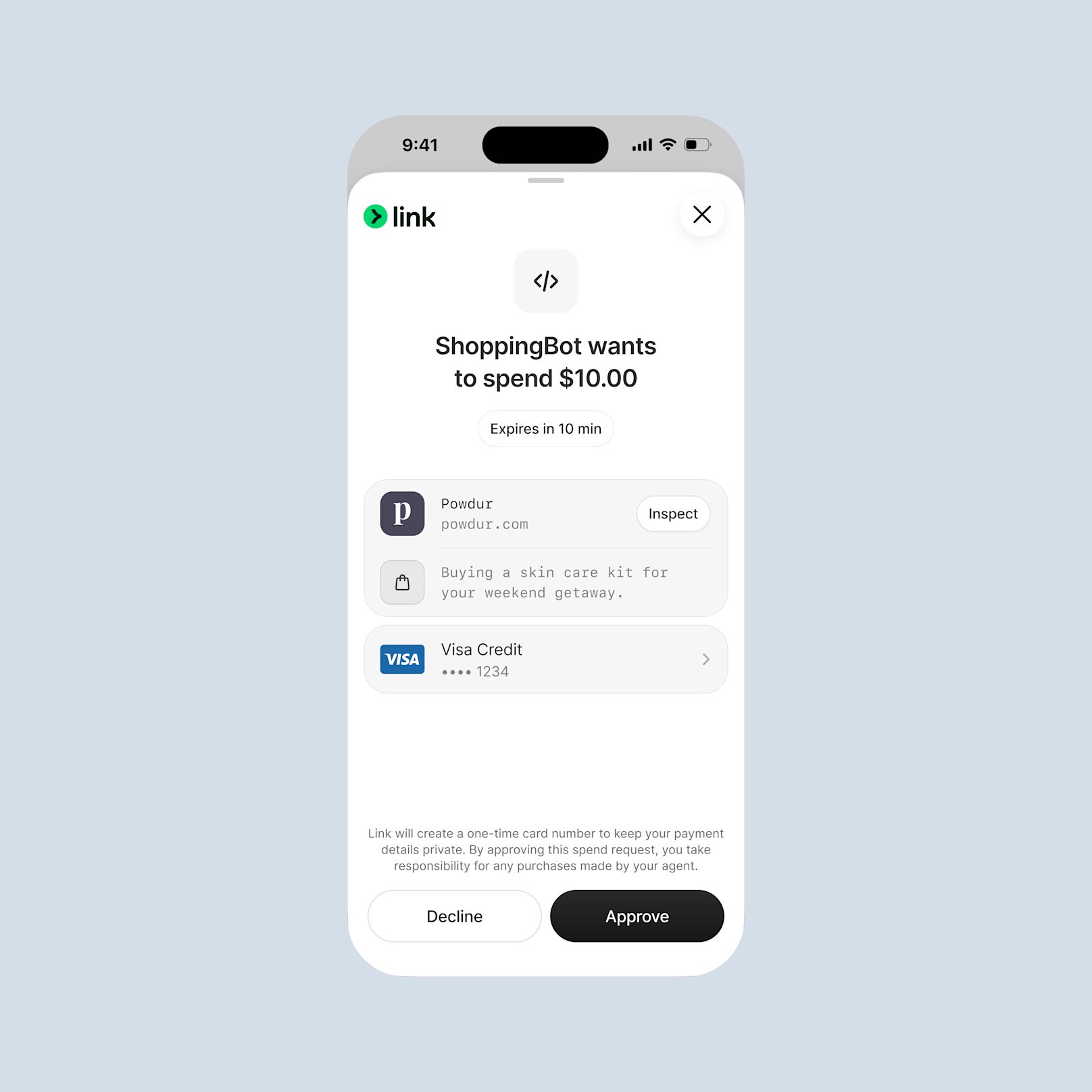
After approval, Link returns the one-time-use card or SPT to your agent for it to complete the purchase. The person can track agent spending and manage connected agents directly in Link.
## Stripe Issuing for agents
Link's wallet for agents is built directly on top of Stripe's Issuing primitives. For businesses that want to build and customize their own agentic wallets and cards, Issuing for agents gives developers access to the full set of [Issuing APIs](https://docs.stripe.com/issuing) to power agentic spending and custom financial workflows for agents and their users.
Businesses can design user-facing experiences to fit their product, including onboarding, fund flows, and spending controls. They can define when and how agents move funds, set permissions at the card level, introduce fraud controls at transaction authorization, and gain visibility into historical and real-time card activity.
Issuing for agents provides the underlying infrastructure for these experiences, from single-use virtual cards and fund storage to spending controls, transaction monitoring, and advanced fraud tools. This infrastructure supports a range of use cases:
- Developers can use agents to automate their own business spend, allowing them to create programmatic workflows and recurring purchases.
- Fintech providers can embed agent-issued cards to control and reconcile spend for expense management in real time.
- Vertical SaaS platforms can issue agent cards to SMB customers, letting agents automate spend under the platform's own brand.
- Marketplaces can issue cards to sellers, so their agents can automate supplier payments, logistics, and fulfillment purchases.
## Get started
[Get started today](https://link.com/agents) with Link's wallet for agents, and [read our docs](https://docs.stripe.com/issuing/agents) to learn more about Issuing for agents.
## How agents, digital wallets, and trust are rewriting checkout
We analyzed checkout activity across more than 20K businesses, surveyed shoppers and ecommerce leaders, and gathered insights from businesses on the Stripe network to understand what’s changing in online conversion.
## Insights from Shoptalk 2026: How agents are changing retail
Retailers know search and discovery have already shifted. What comes next is less settled. From embedded checkout to emerging third-party surfaces, here’s how ecommerce and AI leaders are integrating agentic commerce.
## How Stripe Radar helps prevent free trial abuse
Radar now helps prevent free trial abuse with just one click. When enabled, Radar predicts the presence of abusive behavior that violates common trial terms, such as repeated trial signup or missed cancellations, with 90% accuracy.
## Three of the biggest fraud trends from MRC Vegas 2026
The most sophisticated fraud teams are shifting from one-size-fits-all fraud approaches to more dynamic, tailored interventions. They are removing friction for trusted users, embedding fraud detection directly into agentic transactions, and investing in multilayered identity verification to combat deepfakes.
## Testing the impact of Adaptive Pricing across 1.5M subscription checkout sessions
Adaptive Pricing is now available for subscriptions, allowing businesses to automatically localize prices in 150+ countries while Stripe handles currency conversion. In an A/B test across 1.5 million subscription checkouts, businesses saw 4.7% higher conversion and 5.4% higher LTV per session, on average.
## Introducing the Machine Payments Protocol
We’re launching the Machine Payments Protocol (MPP), an open standard, internet-native way for agents to pay—co-authored by Tempo and Stripe. Businesses on Stripe can accept payments over MPP in a few lines of code using our PaymentIntents API.
## 10 things we learned building for the first generation of agentic commerce
A future where we buy with AI agents feels inevitable. Making it actually work is harder. These lessons from the first wave of agentic commerce are meant to help sellers decide what to tackle, avoid common bottlenecks, and get ahead of what’s coming.